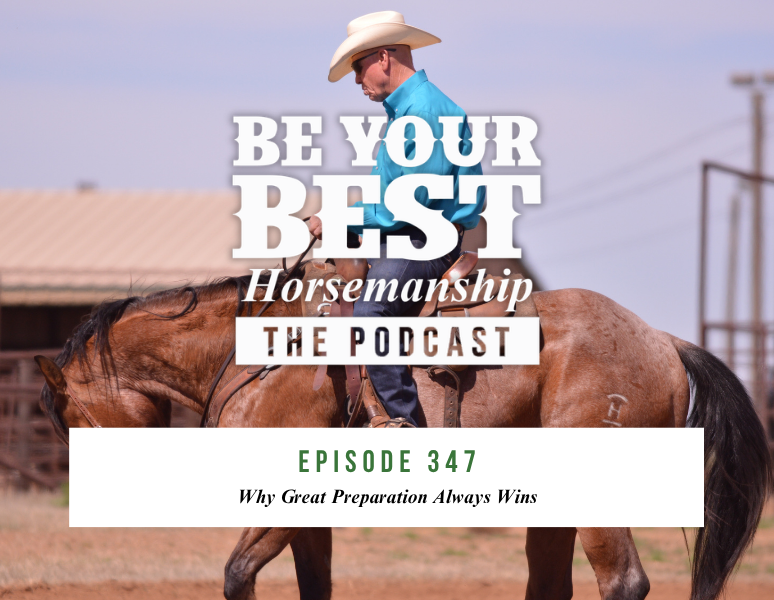
Ep 347: Why Great Preparation Always Wins
One of the biggest lessons horses have taught me over the years is that preparation has a way of showing up when it matters most. You may not always notice the work you've put in on an ordinary day at home, but when you're faced with an unexpected challenge, that's when your preparation either shows—or it doesn't.
Whether you're starting a colt, heading to a jackpot, hauling to a rodeo, or simply trying to become a better horseman, the more prepared you are, the more confident you'll become. Confidence isn't something you wish for. It's something you earn through consistent preparation.
Great Preparation Builds Great Competitors
Watching the Fourth of July rodeos this year was a great reminder of that. Those competitors dealt with rain, mud, tough ground conditions, long miles, and packed schedules. Yet they still found a way to perform at a high level.
People often look at those moments and see talent. I see preparation.
The competitors who consistently perform aren't hoping everything goes perfectly. They've prepared themselves—and their horses—to handle whatever conditions they draw. That's true whether it's deep mud, slick ground, a difficult setup, or a long week on the road.
Life and competition rarely give us ideal conditions. That's exactly why our preparation matters so much.
Preparing Reactive Horses the Right Way
One conversation I had recently was with a trainer working through a challenge with a colt that had become reactive after an unfortunate incident. After several good rides, something spooked the horse, the trainer was injured, and the colt began reacting defensively.
That's a pretty common situation. When horses become reactive, they're operating from the survival side of their brain. They're not trying to be difficult—they're simply trying to protect themselves.
Our job isn't to avoid everything that scares them. Our job is to help them learn they don't need to be afraid.
Sometimes I hear people say, "I don't want to scare my horse." Well, depending on your perspective, someone else might say you're helping that horse get over being scared. There's a big difference.
If you spend your whole time tiptoeing around a reactive horse, you're actually reinforcing the idea that there's something to fear. Instead, I want to expose that horse to situations where they can process the pressure, think through it, and discover they're safe. That's how confidence is built.
Every Horse Requires a Different Approach
One thing I always remind people is that while your philosophy should remain consistent, your application won't always look the same. Every horse is an individual. The fundamentals don't change, but the order, timing, and emphasis might.
Some horses need more groundwork before you ever swing a leg over. Some horses need more emotional preparation. Others simply need more repetitions.
The goal isn't to force every horse through an identical program. The goal is to apply sound principles in a way that best prepares that particular horse.
Preparation Creates Confidence
Another question I received was about mounting young horses. Some trainers like to stand in the stirrup for a moment before swinging over. Personally, once I've prepared a horse correctly from the ground, I prefer to step up and get on.Neither approach is right or wrong.
The important question is this: Is the horse prepared?
If the groundwork has created relaxation, understanding, and trust, then mounting becomes just another step in the process—not something the horse fears. Good preparation removes unnecessary drama.
Sometimes Growth Isn't Comfortable
Preparation doesn't always look pretty. There are times when helping a horse overcome fear requires asking them to work through something that's mentally difficult.
Recently I worked with a horse that had become defensive after bucking me off. After giving him every opportunity to work through the issue, I decided it was time to address the underlying fear that continued showing itself.
That process wasn't about overpowering the horse. It was about helping him discover he could trust me. Sometimes growth requires a little discomfort. That's true for horses, and it's true for people.
The key is knowing the difference between creating unnecessary pressure and applying thoughtful pressure that leads to understanding. Done correctly, those moments create tremendous confidence.
Learn From Different Programs
Preparation isn't just about your horse. It's about preparing yourself, too.
One trainer asked me what I thought about customers getting advice from multiple trainers.
My answer was simple: Go learn. Go ride with different people. Go to clinics. Listen to podcasts. Watch great horsemen. Learn from anyone who can help you grow.
At the same time, remember that no single program is a perfect fit for every person or every horse. Take what makes sense for your goals, your horses, and your philosophy. Growth comes from exposure. Wisdom comes from learning what to keep.
Fundamentals Win Under Pressure
One of the best pieces of advice I heard recently came from watching the Calgary Stampede.
When things weren't going exactly right, the advice was simple: Go back to the basics.
That applies to every discipline. Whether you're roping, barrel racing, reining, ranch riding, or simply riding at home, the fundamentals are what carry you through difficult moments.
When pressure increases, preparation shows itself. That's why I spend so much time talking about basics. They're never glamorous, but they always work.
A Positive Mindset Is Part of Your Preparation
Preparation isn't only physical. It's mental.
I had a run recently where I missed a steer because my horse wasn't comfortable in that particular indoor setup. For about thirty seconds I was frustrated. But before I got back to the trailer, I'd already reframed it. I hadn't learned I couldn't rope. I'd learned something valuable about that horse. That's useful information.
A negative mindset has never produced a positive life. If something doesn't go the way you hoped, ask yourself what you learned instead of beating yourself up over it. The lesson is usually worth more than the mistake.
Great Preparation Always Wins
At the end of the day, preparation is about putting yourself and your horse in the best position to succeed—whether conditions are perfect or anything but.
Expose your horses to new situations. Challenge yourself to keep learning. Stay committed to the fundamentals. Control your self-talk. And remember that confidence isn't built on competition day. It's built every day leading up to it.
When the unexpected happens—and eventually it will—you won't have to rely on luck. You'll be able to rely on your preparation. That's why, in the long run, great preparation always wins.