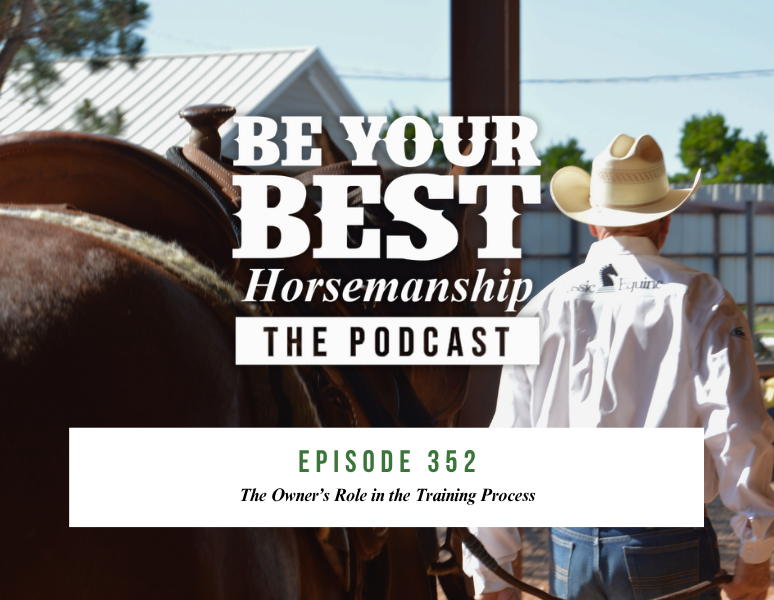
Ep 352: The Owner’s Role in the Training Process
When an owner sends a horse to a trainer, it can be easy to think the responsibility has officially changed hands. You drop the horse off, pay the training bill, and wait for the trainer to produce the result you’re hoping for. But that’s not really how a successful training program works.
The owner still plays an important role, not only while the horse is in training, but long before that horse ever arrives at the trainer’s barn.
From the preparation a young horse receives as a weanling and yearling to the communication that happens throughout the training process, the owner’s involvement can make a tremendous difference in how successfully that horse progresses.
Be Clear About What You Want
As a trainer, I want owners to be involved. I want to know what their goals are, what they hope that horse will eventually become, and what they expect from the training program. That conversation needs to happen right up front.
The more clearly an owner communicates what they want, the more honestly the trainer can respond. Sometimes the goal is realistic. Sometimes the horse may need more time. Sometimes the horse may not be suited for what the owner has in mind.
Those conversations aren’t always easy, but avoiding them doesn’t help anybody—especially the horse. The trainer’s responsibility is to be honest about what they see. The owner’s responsibility is to be honest about what they expect. When both sides understand the goal, you have a much better chance of building a program that makes sense for that horse.
Understand What a Trainer Can Actually Guarantee
My dad taught me a long time ago that the only thing you can truly guarantee is that you’ll show up and do your job the best you can that day. That applies to training horses.
A trainer can guarantee their effort. They can apply their knowledge, experience, and feel to the horse standing in front of them. But they can’t guarantee that every horse will progress at the same speed or reach a certain level by a certain date.
Some trainers may be able to accomplish more in a day because of their experience and ability. But even the best trainers are still working with that individual horse, where that horse is mentally and physically on that particular day. That’s why realistic expectations are so important.
Training isn’t manufacturing. A horse isn’t a programmed computer where you put in a certain number of days and automatically get the same result every time.
Give Your Trainer Permission to Be Honest
I currently have a young woman putting barrel-racing runs on one of my horses. When I sent him to her, I told her I wanted her to take her time and do it right. I also told her that if she reached a point where she didn’t feel like the horse was going to work for that discipline, I wanted her to call me. She wasn’t going to offend me. In fact, that honesty is exactly what I want from someone riding one of my horses.
If a trainer doesn’t believe in the horse or doesn’t feel that the horse is suited for what they’re trying to accomplish, the owner needs to know that. Continuing to force the situation usually isn’t fair to the trainer or the horse.
As an owner, you have to create enough trust in that relationship that your trainer can tell you the truth—even when it isn’t what you hoped to hear. That doesn’t mean giving up on the horse. It may simply mean changing the discipline, changing the program, or finding a situation that better fits the horse’s strengths.
Stay Involved Without Micromanaging
There’s a difference between being involved and trying to manage every ride from a distance. As an owner, I believe you should communicate with your trainer regularly. About once a month, sit down or have a phone call and evaluate where things stand. Ask how the horse is progressing. Talk about any challenges that have come up. Revisit your expectations and timeline. Make sure the direction of the program still matches the goal you originally discussed.
That doesn’t mean calling every day and asking what the horse accomplished. Training isn’t always that linear. Sometimes progress means moving forward. Other times it means backing up and reinforcing part of the foundation. Even a horse with a great deal of training will need to return to the basics from time to time. That isn’t failure. That’s part of maintaining a solid horse.
Invest in Learning the Program Yourself
The owner’s responsibility doesn’t end when the horse comes home, either. If a trainer has spent months developing softness, body control, confidence, and responsiveness, the owner needs to understand how those things were taught.
I recently had a customer pick up a really nice gelding. They were happy with the horse and the program, but I told them something I believe very strongly: Until you invest in yourself and understand the foundation that has been put into that horse, you’ll never get the maximum out of him.
The owner doesn’t need to become a professional trainer. But they do need to understand the basic signals, release points, and expectations the horse has learned. Otherwise, the owner may unintentionally confuse the horse or slowly undo parts of the foundation they paid the trainer to build. A well-trained horse still needs a rider who understands how to communicate with him.
Be Flexible With Your Timeline
Timelines are one of the hardest parts of the owner-trainer relationship. Owners usually have a date in mind. They want the horse ready for a futurity, a sale, a competition season, or a particular event. Goals and deadlines can be helpful because they give the program direction. But the horse doesn’t know what date you circled on the calendar.
More often than not, the timelines people bring into a training program are unrealistic. That doesn’t mean trainers want the process to take longer. Every trainer would like to find the easiest, most efficient path forward. But the horse determines the pace.
Some horses mature faster mentally. Some need more time to build confidence. Some have physical ability that develops much faster than their mind can handle. You can’t rush mental readiness just because the horse looks physically capable. The owner’s job is to have a goal while remaining flexible enough to make decisions based on what the horse actually needs.
Training Begins Before the Horse Is Old Enough to Ride
One of the biggest responsibilities owners and breeders have is preparing young horses before they reach riding age. We often allow weanlings and yearlings to grow physically without doing enough to develop them mentally. Then, when they’re two or three years old, we hand a trainer a big, strong, athletic horse that has very little understanding of pressure, release, patience, or how to think through a situation.
Physically, that horse may look ready. Mentally, he may be far behind. That creates an unnecessary gap in the training process.
Why wouldn’t we teach a weanling how to look for a release? Why wouldn’t we help a yearling learn to think instead of immediately becoming reactive or defensive?
The release point doesn’t change because of the horse’s age. Whether the horse is a weanling or 25 years old, the basic learning process remains the same.
The earlier we help that horse understand how to search for the right answer, the better prepared he’ll be when it’s time to start him under saddle.
Develop the Mind Without Breaking Down the Body
Working with young horses does not mean physically drilling them or asking them to perform before their bodies are ready. The goal is to develop their minds.
A well-prepared young horse can learn to be haltered, tied, led, handled, and comfortable with basic equipment. He can learn patience. He can learn to move away from pressure and search for the release. Those experiences prepare him to think.
Then, when it’s time to introduce the saddle, bridle, and rider, the entire process feels more familiar. Instead of reacting to every new sensation, the horse already has a habit of slowing down and looking for an answer. That early preparation can completely change the starting process.
If I can work with a horse as a weanling, again as a yearling, and then start him as a two-year-old, it’s a different ball game than receiving a physically mature horse that has barely been handled. You’re not starting from zero. You’re building on a foundation that has already been developing for years.
Simple Handling Makes a Major Difference
Preparing young horses doesn’t always require long training sessions. The weanlings at our place have been haltered. They’ve been tied. They can stand at a bucket and eat their grain like the older horses. Sometimes I may only work with one for five minutes, but those five minutes matter.
That consistency teaches the horse how to stand, wait, process pressure, and be part of a daily routine. By the time those horses are ready to ride, they already understand many of the expectations that would otherwise have to be introduced all at once.
Whether the horse eventually stays in my program or goes to another trainer, that preparation puts everybody ahead. It helps the horse. It helps the trainer. And ultimately, it helps the owner get more value from the training process.
Physical Talent Isn’t Enough
The horses being bred today are tremendous athletes. They have more speed, power, and natural ability than ever before. But all that ability creates another challenge: controlling it.
A horse’s mind has to be capable of handling the speed and power his body can produce. When the body gets ahead of the mind, that’s when horses can become overwhelmed, reactive, or defensive.
I’ve seen talented young horses struggle because mentally they weren’t ready to process what their bodies were being asked to do. That’s not always a lack of effort from the owner or trainer. Sometimes people are trying incredibly hard. But effort alone can’t replace mental preparation.
One of the best things an owner can do is begin developing that thinking side early, long before the horse is asked to perform at speed.
Give Your Horse the Best Opportunity to Succeed
The owner’s role in the training process is bigger than choosing a trainer and paying a monthly bill. It means preparing the horse before training begins. It means communicating your goals honestly. It means listening when the trainer gives you an honest evaluation. It means staying involved without micromanaging. It means being flexible when the horse needs more time. And it means investing in your own horsemanship so you can maintain and build upon the foundation once the horse comes home.
Training works best when the owner and trainer operate as a team. But ultimately, both people are working for the same individual—the horse. When the owner does their part before, during, and after the formal training process, they give that horse the best possible opportunity to develop into everything he has the potential to become.