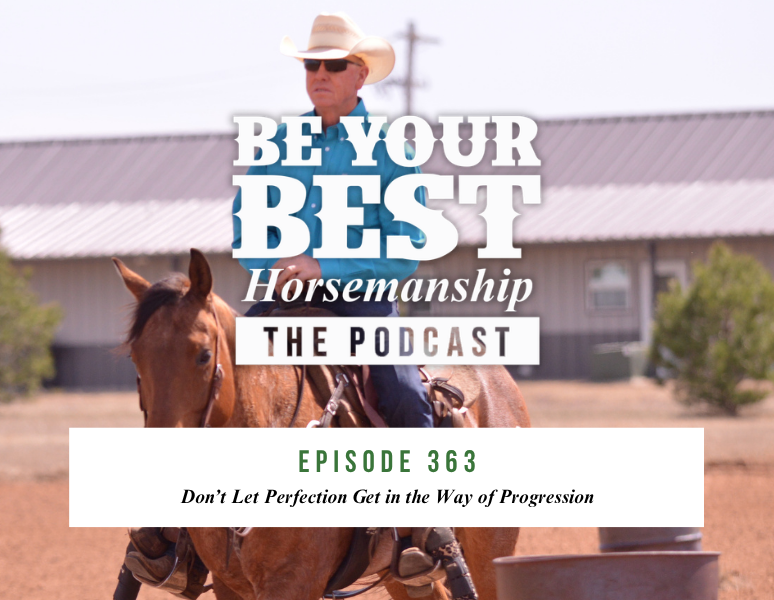
One of the things I've learned over the years is that we can get so focused on what our horses aren't doing right that we overlook all the things they're doing well.
I see it quite a bit when I'm teaching clinics. I'll be watching somebody work with their horse, and I can see a lot of good things happening. But when I talk to that rider, they're focused on the one or two things that aren't quite where they want them to be. And, I understand that because I've been there.
As trainers, we have a tendency to recognize the things that are challenging us and make those things bigger than they really are. Pretty soon, we're spending more time trying to fix every little mistake than we are recognizing the progression our horses are making.
But here's something I want you to think about: If the only time you're satisfied with your horse is when everything is perfect, you're going to have a hard time building the confidence and willingness you're looking for.
It's not about getting everything perfect today. It's about making quality progression and rewarding that progression along the way.
The Pursuit of Perfection Can Work Against You
The pursuit of perfection has ruined a lot of good horses and a lot of good trainers.
I'm not saying that because I read it somewhere or heard somebody else talk about it; I'm saying it because I lived it.
Earlier in my career, I was that guy who thought everything had to be perfect. I was constantly picking on my horses, trying to make every little thing better.
I thought I was helping them improve. But looking back, I was creating a lot of unnecessary pressure.
Think about it this way: If you've ever been around somebody who constantly picks on another person, you know what that does to their confidence.
It doesn't make them better. It doesn't make them more willing to try. It wears them down.
Our horses are no different.
When we constantly pick, pick, pick at every little mistake, we're not necessarily developing a better horse. We're often creating a horse that's anxious, defensive, and unsure of what we're looking for.
Pretty soon, that horse starts anticipating the next correction instead of confidently searching for the right answer. That's not the kind of relationship I want to have with my horses.
Reward the Progression, Not Just the Perfect Response
One of the biggest changes I've made in my training program is learning to base my expectations on progression rather than perfection.
If I go out to work horses today and I can get some quality progression out of each one of them, that's a good day.
It doesn't matter if everything isn't exactly where I eventually want it to be. What matters is that we're moving in the right direction.
If you continue to recognize and reward quality progression, you're going to get closer and closer to the finished result you're looking for.
But if you're so focused on perfection that you overlook the smaller improvements, you can actually slow that process down. When you take that expectation of perfection off yourself and your horse, it takes a lot of pressure out of the situation.
You can relax a little bit. You can be more patient. You can focus on doing a good job with the steps that are right in front of you instead of constantly worrying about how far you still have to go.
I think that's a much better environment for both the horse and the rider.
Your Horse's Body Language Will Tell You a Lot
During our recent clinics in Devils Lake and Twin Buttes, North Dakota, we spent quite a bit of time talking about feel and body language. And to me, those two things go hand in hand.
Think about how you read another person's body language. You can watch somebody walk into a room, and a lot of times, before they ever say a word, you have a pretty good idea of what kind of mood they're in or what they're thinking.
Horses are much the same way. When we're working with them on the ground, they're watching our movements and learning to recognize what those movements mean.
When we're on their back, they're reading our body language through feel. The way we shift our weight, position our body, and communicate through our hands all become signals that our horses can learn to recognize.
But that communication goes both ways. We need to be just as aware of what our horses are telling us.
One of the things I enjoy about teaching clinics is watching how the horses change throughout the day.
At both of those recent clinics, we had some really good horses and some very capable riders. And as the clinics progressed, you could see a difference in the horses' body language. They became more comfortable, more confident, and more responsive as their riders cleaned up their communication.
That's one of the things I look for when I'm evaluating progression. Not just whether the horse completed a particular maneuver, but how he felt about doing it.
Was he relaxed? Was he listening? Was he searching for the answer? Did he become softer and more confident as we worked through the exercise?
Those things tell me a lot about the quality of our communication.
Make Your Signals Mean Something
One of the things I encourage people to think about is being present and intentional with every movement they make. Because every movement you make around your horse is either teaching him that your body language means something or that it doesn't.
If we're constantly moving around without being intentional, or if our hands are always getting ahead of our body, pretty soon our horses stop paying attention to those smaller signals.
Then we find ourselves having to use more pressure to get the same response.
That's where developing feel becomes so important.
For example, something as simple as closing your hand around your rein can become a signal to your horse.
You don't necessarily have to immediately pull. Give that horse an opportunity to recognize the change and respond.
If our hands get ahead of our body language, we can surprise our horses and cause them to become defensive. And when a horse gets defensive, we start seeing the very things we're trying to eliminate: stiffness, resistance, tension, and a lack of balance.
So rather than constantly correcting those symptoms, sometimes we need to look at how we're asking for the response in the first place.
Are our signals clear? Are we giving the horse enough time to understand what we're asking? Are we recognizing the correct response and rewarding it? Or are we so focused on getting everything perfect that we're creating unnecessary pressure?
Those are questions worth asking ourselves every time we work with our horses.
Don't Confuse Repetition With Progression
Repetition is an important part of developing consistency.
It's how we create muscle memory, both in ourselves and in our horses.
But repetition can work for us or against us. If we're constantly practicing with inconsistent signals, poor timing, or too much pressure, we're still creating habits. They just might not be the habits we want.
You can be working really hard and not making much progression. That's why I encourage people to slow down and pay attention to the quality of what they're doing.
Think about the response you want. Think about how you're going to ask for it. Give your horse an opportunity to recognize your body language and respond. And when he finds that answer, be timely with your release and give him a moment to enjoy it. Don't immediately turn the end of one exercise into the beginning of the next.
When we do that, we can create a horse that's constantly wondering what's coming next. Instead of finding confidence in the release, he becomes anxious about the next request.
Sometimes we need to slow down enough to let the horse recognize that he did something right.
And that brings me to another point that I think is especially important…
Know When to Quit
This is something I see people struggle with quite a bit, and I've certainly made the same mistake myself.
We work on something with our horse, and maybe it's been a challenge for a while.
Then, all of a sudden, the horse really starts to figure it out.
He gives us a great response. He's trying hard. Everything starts coming together.
And what do we want to do?
We want to do it again. And again. And again.
Because it feels good to finally have that success.
But sometimes, the best thing we can do when our horses give us a really good effort is reward them and quit.
Think about it from the horse's perspective. If every time he tries his hardest and gives us what we're asking for, we reward him by asking for 10 more repetitions, what are we teaching him?
It's a lot like an athlete working with a coach.
Imagine you've just given everything you've got to complete an exercise, and your coach says, "That was great. Now let's do 10 more."
Pretty soon, you might start holding a little something back.
You don't know when you're going to be finished, so you start saving your energy.
Our horses can develop that same mentality.
But if I ask my horse for a response, he gives me a really good effort, and I reward that effort by letting him be done, there's a pretty good chance he's going to develop a habit of trying hard for me.
And that's what I want.
Now, that doesn't necessarily mean you have to end your entire training session every time your horse makes a breakthrough.
You might leave that exercise alone, go do something else for a while, and come back to it later. But recognize when you've gotten the progression you were looking for. Reward the effort. And know when enough is enough.
Sometimes Less Pressure Creates More Progress
Years ago, Ray Hunt told me something that has stuck with me: When you step into that round pen, that horse doesn't care how much time you have or don't have.
We might have a schedule we're trying to keep, a competition we're preparing for, or a certain amount of work we think needs to get done. But our horses don't know any of that. They only know what we're asking of them and how we're making them feel in the process.
I've often said that if you approach something like you've only got 15 minutes to get it done, it might take you an hour or two. But if you approach it like you've got all day, sometimes you can accomplish it in 15 minutes. That's the value of patience.
When we get in a hurry, we tend to create more pressure, more resistance, and more problems that we have to work through. But when we slow down and focus on quality progression, we give our horses a better opportunity to understand what we're asking. And a lot of times, we end up accomplishing more with less effort.
Make Progress the Goal
As you go through your training program, I want to encourage you to pay attention to what you're choosing to focus on.
Are you recognizing the things your horse is doing well?
Are you giving him credit for the effort he's putting forth?
Are you noticing the small improvements in his confidence, understanding, and body language?
Or are you spending so much time looking for what's wrong that you're overlooking what's right?
We all want to improve. We all have goals we're working toward, and there's nothing wrong with having high expectations. But I think we have to be careful that those expectations don't get in the way of the progression we're trying to create.
You don't have to get everything perfect today. You need to get a little better. And then tomorrow, you go out and try to get a little better again.
Reward the effort. Recognize the progression. And don't be afraid to quit when your horse has given you what you were looking for.
Because at the end of the day, the goal isn't to have a horse that's afraid to make a mistake.
It's to develop a horse that's confident, willing, and understands how to work with you.
And I believe the more intentional we become about recognizing and rewarding progression, the better opportunity we give our horses to reach their full potential.