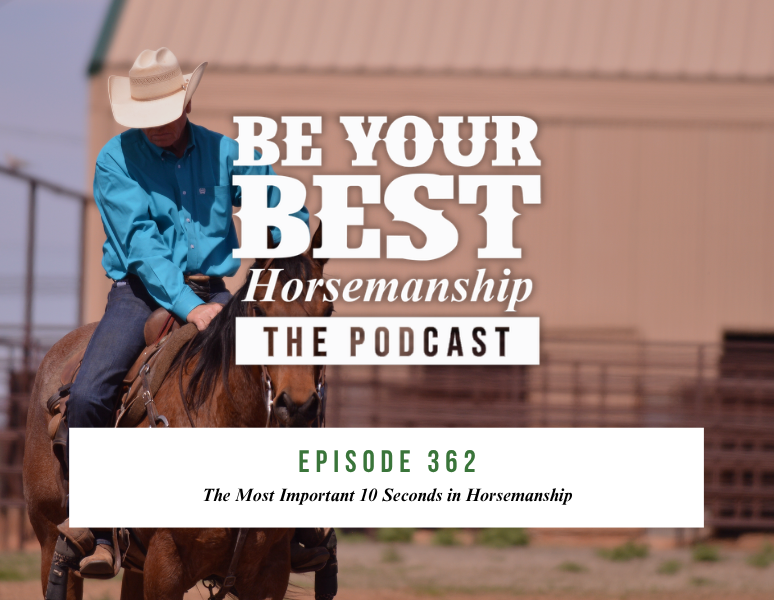
I think one of the things we struggle with the most as horsemen is knowing when to just sit still and do nothing.
And I'm putting myself in that category, too.
Earlier in my career, I wasn't very good at slowing down. I was always thinking about the next maneuver, the next response, or what I needed to accomplish before the end of the day. I wanted to be efficient, and I figured the more I could get done in a training session, the more progress I was making.
But I've learned over the years that sometimes the most productive thing we can do for our horses is absolutely nothing.
During a recent clinic in Lyons, Michigan, we spent quite a bit of time discussing the value of patience and the pause. It's a simple concept, but I believe it's one of the most important things we can learn to incorporate into our horsemanship.
Years ago, someone told me, "If you haven't got 10 seconds to let that horse enjoy the release, you need to just get off."
He was absolutely right. And, I'm pretty sure he was telling me that because he'd been watching me get in too big of a hurry.
The Value of the Pause
Every time we ask a horse for a response, we're trying to help him understand what we're asking and how to find the correct answer.
We apply a signal. The horse searches for the response. When he finds it, we provide the release.
That's how we begin to develop understanding.
But there's another part of that process that I think we overlook far too often.
After we provide the release, we need to give that horse a moment to appreciate it.
Just sit there.
Let him enjoy the reward of finding the correct answer. Let him relax, regain his confidence, and recognize that he did what we were asking.
It doesn't have to be a long period of time. I'd like to see us give them 10 or 15 seconds, but even five seconds can make a difference.
The important thing is that we're giving the horse an opportunity to process what just happened before we move on to the next thing.
Think about how often we ask for a response, get what we want, and immediately start thinking about what we're going to do next.
Our minds are already three steps ahead.
But our horses can't read our minds. They don't know what we're planning to ask next.
All they know is what we're communicating to them in that moment.
And if we're constantly moving from one request to another without giving them time to recognize the release, we're missing an opportunity to build their understanding and confidence.
Are You Bringing the Hurry Into Your Horsemanship?
We live in a world where everything is about getting more done in less time.
We've got schedules to keep, responsibilities to manage, and a list of things that need to get accomplished before the day is over.
I understand that as well as anybody. That's how I'm wired.
But one of the things I've had to learn is that I can't let the pace of everyday life dictate how I work with my horses.
It's easy to carry that urgency into the arena without even realizing it.
Maybe you're running behind. Maybe you've got several horses left to ride. Maybe you've been working toward a particular goal, and you feel like you're not progressing as quickly as you should.
Pretty soon, you start feeling pressure.
And when you feel pressure, what happens?
You speed up. Your hands get quicker. You get a little stiffer. You become less patient with the horse.
Now, instead of helping that horse understand what you're asking, you may actually be making the process more difficult.
Getting in a hurry doesn't necessarily speed up your training. In a lot of cases, it slows you down.
I've experienced that plenty of times throughout my career, and I still have days when I catch myself falling back into those old habits.
The difference is that I'm much more aware of it today.
When I recognize that I'm getting ahead of myself, I know I need to slow down, clean up my signals, and give that horse a better opportunity to find the answer.
Give Your Horse Time to Think Instead of React
One of the things I talk about frequently is the importance of recognizing whether a horse is thinking or reacting.
I look at it like a switch.
When a horse is on the thinking side, he's in a position to understand what we're asking, search for the correct response, and build confidence through the experience.
When he's on the reactive side, he's operating more out of anxiety, insecurity, or self-preservation.
And when that happens, we may be able to physically control the horse to a certain degree, but that doesn't necessarily mean we've established the understanding or connection we're looking for.
During our Michigan clinic, we worked with a few horses that were fairly anxious and reactive.
One of the things we focused on was helping those horses get back to a place where they could think.
That's where our timing, feel, and patience become so important.
If I can communicate clearly, recognize when that horse begins searching for the correct answer, and reward the response with a timely release, I'm helping him develop confidence in the process.
Then, when I give him a moment to enjoy that release, I'm reinforcing that confidence.
I'm allowing him to recognize that he found the answer and that there's comfort in doing what I'm asking.
Over time, those experiences begin to change how that horse approaches the next challenge.
Instead of immediately reacting when something becomes uncomfortable or unfamiliar, he has a better opportunity to slow down, think, and search for the answer.
That's the kind of progression we're looking for.
Sometimes We Need to Retrain Our Own Hands
Another thing that goes right along with patience is learning to slow our hands down.
Our natural tendency as riders is to react with our hands as soon as we have a thought.
We want the horse to move a certain direction, change his position, or respond to something, and our hands immediately go to work.
But sometimes we're doing too much—especially with young horses.
We know they're inexperienced, so we don't always trust them to find the answer on their own. We feel like we need to help them through every little thing.
And while there are certainly times when a horse needs that support, we also have to learn when to give him an opportunity to respond without micromanaging every movement.
I'm currently working with a young colt that we're filming through his first 60 rides.
He's a big, strong horse that came to us with very little handling, and he's been a great example of why patience matters.
During one of our recent rides, I was working on developing some lateral softness.
If I simply slid my hand down the rein and squeezed, giving him a moment to understand the signal, he'd find that softness.
But if I immediately turned that signal into pressure by pulling on him, he'd stiffen up and resist.
That additional pressure triggered him to defend himself instead of searching for the response I wanted.
Same horse. Same exercise. Completely different result based on how I communicated with him.
That's why I put so much emphasis on cleaning up our signals and improving the timing of our releases.
Sometimes we need to give that horse just another second to figure things out. And sometimes we need to have enough confidence in our training to leave him alone.
Smooth Is Always Fast
You've probably heard me say that smooth is always fast.
I believe that applies to just about everything we do with our horses.
When you watch a really good horseman, there's usually a smoothness to the way they ride.
They're not constantly reacting with their hands or trying to force every movement.
They're using their body language, communicating through clear signals, and allowing the horse to recognize what's being asked before providing additional support.
That's something we work on quite a bit with our rope horses.
When I'm riding Boone, for example, he understands the position I want him to find when we're setting up a shot.
He knows where that release point is.
And when he gets there, I leave him alone.
He can settle into that position because we've spent time developing his understanding of what I'm asking.
He doesn't need me constantly adjusting him with my hands.
That understanding creates confidence, and confidence allows him to perform his job more consistently.
But it didn't happen overnight.
It came from repeating those experiences, being consistent with my signals, and allowing him to recognize when he'd found the correct answer.
Whether you're working with a young colt or a finished performance horse, those same principles apply.
You Might Get More Done by Doing Less
Here's something I've come to believe more and more as I've gotten older.
If I can slow down, be smooth and consistent with my signals, provide a timely release, and be patient enough to let that horse enjoy the pause, I can get twice as much done with half the effort.
I truly believe that.
And I've experienced it.
When I'm really present in what I'm doing and paying attention to those details, my training sessions are more productive.
The horse understands what I'm asking. There's less resistance, less frustration, and less time spent trying to correct problems that I may have created by getting in a hurry.
Now, that doesn't mean every ride is going to be perfect.
There are still going to be challenges. There are still going to be horses that make you work for every bit of progression.
But the answer isn't always to do more.
Sometimes the answer is to do a better job with the little things.
Be clearer with your signal.
Give the horse an opportunity to respond.
Be timely with your release.
And then, for just a few seconds, don't do anything.
That's not a complicated training technique. It doesn't require any special equipment or years of experience.
Anybody can learn to do it.
But you've got to be disciplined enough to make it a habit.
Make the Pause Part of Your Training Program
I want to encourage you to pay attention to this during your next training session.
When you ask your horse for something and he gives you the response you're looking for, be intentional about what happens next.
Don't immediately start thinking about the next maneuver.
Provide the release, sit quietly, and give him a chance to enjoy that moment.
Pay attention to how he responds.
Does he begin to relax? Does he become more comfortable? Does he start searching for the correct answer a little sooner the next time you ask?
Those are the things we need to be looking for.
And while you're paying attention to your horse, pay attention to yourself, too.
Are you getting in a hurry?
Are you using your hands more than you need to?
Are you giving your horse enough time to understand what you're asking, or are you immediately increasing the pressure because he didn't respond as quickly as you expected?
Those are questions I still have to ask myself.
Horsemanship is a journey. We're never going to reach a point where there's nothing left to improve.
But I think if we can become more aware of these little things and make a commitment to improving them, we'll see a tremendous difference in our horses.
Remember, the release is the reward, but we've got to give the horse an opportunity to appreciate it.
Sometimes the most valuable 10 seconds of your entire training session are the 10 seconds when you simply sit still and do absolutely nothing.
Today and every day, let's be our best.