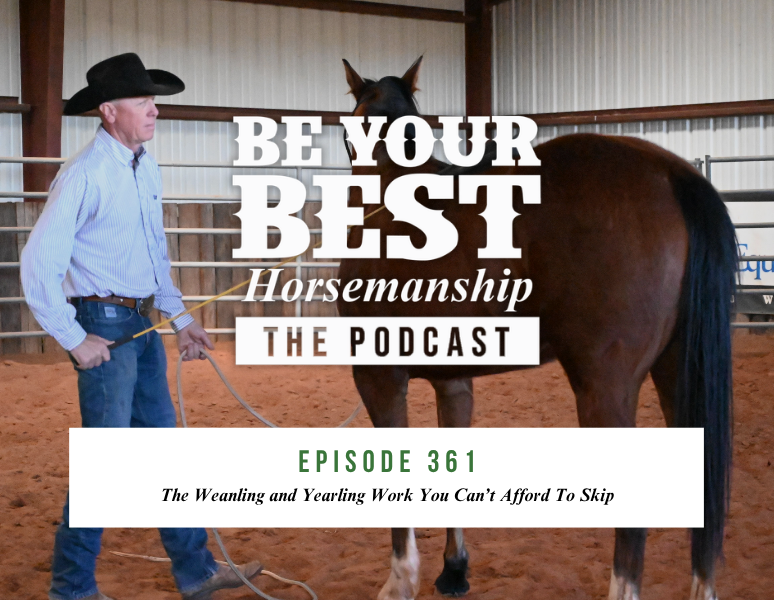
Ep 361: The Weanling and Yearling Work You Can’t Afford To Skip
When we talk about colt starting, most people think about putting the first rides on a two-year-old. But, I believe some of the most important work we can do with a young horse happens earlier.
If you're waiting until a horse is two years old to start developing his mind, you may already be behind.
That doesn't mean we need to rush young horses or put them through a training program they're not physically ready for. Quite the opposite. It means recognizing that a horse's mental development needs to progress right alongside his physical development.
During our recent Colt Starting Mentorship, we worked with two-year-olds, long yearlings, and weanlings. And while putting those first rides on the two-year-olds was rewarding, I would argue that some of the most valuable work we did all week was with the younger horses.
Don't Wait Until They're Two to Start Developing Their Minds
We have some incredibly talented, athletic horses being raised in our industry today. With the genetics available to us, it's not uncommon to see a two-year-old that's already big, strong, and physically capable of doing quite a bit.
But what happens when that horse's mind hasn't developed at the same rate as his body? That's when we run into problems.
You have a physically mature horse that may not understand how to respond to pressure, recognize a signal, or think through a situation that makes him uncomfortable.
Now, instead of simply progressing that horse through the colt starting process, we're having to catch his mind up to his body.
By introducing some foundational training during the weanling and yearling stages, we can begin developing a horse's understanding and confidence before we ever ask him to carry a rider. That preparation can make a tremendous difference when it's time to start him under saddle.
What Should We Be Teaching Weanlings and Yearlings?
The goal of a weanling or yearling program isn't to see how much we can get done with a young horse. It's to establish an understanding of how to learn.
I want those horses to begin recognizing signals, searching for the correct response, and understanding where the release comes from.
That might include learning to follow a lead rope, move away from pressure, disengage their hindquarters, or become more comfortable with movement and unfamiliar situations.
For example, when I'm working with a flag, I don't want a young horse to believe he has to jump every time that flag moves. I want him to learn that movement doesn't automatically mean something is going to hurt him.
But if I use that flag to apply a signal to his hip, I want him to understand that I'm asking him to move away from that pressure.
There's a difference between simply getting a horse accustomed to something and teaching him how to think through it.
We're not just desensitizing the body. We're developing the mind. And, that understanding becomes the foundation for everything else we ask of that horse down the road.
Clear Signals and Releases Build Confidence
One of the biggest things we emphasized throughout our mentorship was the importance of being clear with our signals and our releases.
When you're working with a young horse, especially one that's never been through a formal training program, your expectations are usually pretty simple.
You're happy to see a small amount of progression.
You ask for a response. The horse searches for the answer. When he finds it, you release.
That's how understanding develops.
But as we start making progress, it's easy to get ahead of ourselves.
We begin thinking about the next thing we're going to ask before we've clearly rewarded the response we just received.
Maybe our signal wasn't as clear as it should have been. Maybe we were a little late with our release.
Do that consistently enough, and you start creating frustration and anxiety.
Now the horse is second-guessing himself. He's not sure whether he found the right answer because we haven't communicated it clearly.
That's especially important with weanlings and yearlings. We're establishing their earliest understanding of how pressure and release work.
I want that horse to learn that when he feels a signal, he can search for an answer and find a release.
The clearer we can make that process, the more confidence we begin to build.
The Right Preparation Can Put You Months Ahead
One of the things I talked about during the episode is how much of an advantage this early work can create when a horse reaches his two-year-old year.
Let's say we spend a few weeks working with a weanling and another month or so with that horse as a yearling.
We're not working him hard. We're not asking for anything physically demanding. We're simply establishing a foundation of understanding.
By the time that horse is ready to be started under saddle, he already knows how to recognize pressure, respond to a signal, and search for the release.
He's been introduced to new experiences. He's learned to be more comfortable with the training process.
Instead of spending the first several weeks trying to establish those fundamentals, the colt starter has something to build on.
In my opinion, that preparation can put a horse three or four months ahead in his training progression. And for those of you involved in the futurity industry, you know how valuable that time can be.
The important thing is that we're not getting ahead by pushing a young horse harder. We're getting ahead by preparing him better.
Some Horses Need That Early Work More Than Others
We had a weanling in our mentorship that really reinforced this point for me. He's a stout, athletic colt with a tremendous amount of ability. He's smart, but he's also very reactive.
Paige Whittaker spent quite a bit of time working with him throughout the week, and I kept thinking about what that horse might be like if we turned him out and didn't handle him again until he was two.
By that time, he's going to be a whole lot bigger and stronger.
But without some of this early preparation, he could still have the same reactive mindset he has today.
That's not a combination I want to deal with when it's time to start riding him.
The work we did with that colt wasn't about making him physically stronger. He's going to develop that strength on his own.
It was about helping him become more mentally prepared to use the ability he already has.
Not every colt is going to present the same challenges. Some are naturally quieter and easier to work with. Others are extremely athletic, sensitive, or reactive.
But I believe all of them can benefit from having a better understanding of what's expected of them before they enter the next stage of training.
Progression Matters More Than the Timeline
Now, I want to be clear about something—I'm not suggesting we need to get out there and work weanlings and yearlings like they're mature performance horses.
We have to respect their physical development.
During our mentorship, we weren't asking those younger horses to do anything strenuous. A slow trot was about the most we asked for, and much of the work was focused on simple responses and developing their confidence.
There were also periods during the summer when I chose not to work our weanlings because of the extreme heat. I wasn't willing to put them under unnecessary physical stress just to stay on a training schedule.
That's part of having a good program.
You have to know what you're trying to accomplish and be willing to adjust based on the horse in front of you.
I use a series of foundational steps when starting colts, but those steps are a guide, not a rigid timeline.
Each step should help prepare the horse for the next one.
And whether I'm working with a weanling, a yearling, or a finished performance horse, I keep coming back to the same question:
Am I in a better place with this horse than I was when we started today?
That's quality progression.
It's not about how many things we checked off the list or how quickly we got through them.
It's about making meaningful progress in a way that horse can understand.
Invest in the Foundation Before You Need It
I believe there's a tremendous opportunity for breeders, owners, and trainers to put more emphasis on weanling and yearling development.
We spend a lot of time and money producing talented horses. We study bloodlines, make breeding decisions, and invest in giving those horses every opportunity to succeed.
But we can't overlook the importance of developing the mind that goes along with all that physical ability.
You don't have to be the person who puts the first ride on a horse to influence how successful that horse's training will be.
The work you do with him as a weanling or yearling can make the next trainer's job easier, safer, and more productive.
And ultimately, that's what we're after.
We want horses that are confident, willing, and mentally prepared for the challenges we're going to present throughout their lives.
That starts with the little things. A clear signal. A timely release. One more opportunity to think instead of react.
You don't have to accomplish everything today.
You just have to keep building a foundation that will make tomorrow's work a little easier.