You may never consider yourself a colt starter, but if you're breeding, raising, owning, or handling young horses, you're already influencing their training.
Every time you interact with that weanling or yearling, you're teaching them something. You're creating responses and establishing habits. You're influencing whether that horse learns to think through pressure or react to it.
In my mind, if you're handling a horse, you're training a horse. The question is whether that influence is moving them in the direction you want them to go.
That's why I put so much value on what happens during those early years.
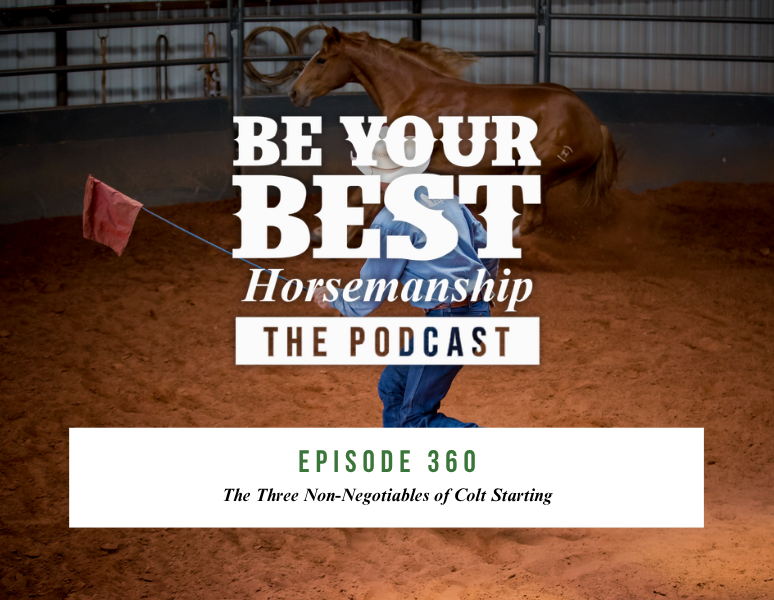
There are three things I keep coming back to throughout the process: connection, collection, and confidence.
Those three C's aren't limited to the first 30 or 60 days under saddle. They're principles I want to establish early and continue developing throughout that horse's training.
#1: Connection: Creating Communication, Trust and Respect
Before I worry about what I can make a young horse do, I want to establish a connection.
One of the most important things you can learn when working with horses is how to recognize whether that horse is thinking or reacting.
I look at it like a switch. The horse is either on the thinking side or the reactive side. Colt starting makes that switch especially easy to see because you're introducing so many new things in a short period of time.
My job isn't to overpower the reaction. My job is to help that horse get back to a place where he can think.
That's where connection comes in.
When I establish connection with a horse, I'm beginning to build communication, trust, and respect. I'm teaching that horse to wait for me, recognize a signal, search for the response I'm asking for, and find the release.
That doesn't happen because I walk into the round pen and demand that a colt trust me.
Trust and respect are earned, not owed.
Especially with a young horse, I have to earn enough trust to get to the next step. Then I earn a little more. We continue building from there. That's progression.
That’s one reason I believe so strongly in doing this work with weanlings and yearlings instead of waiting until they're two and expecting somebody else to establish the entire foundation when it's time to ride them.
You can see the difference that early connection can make. If we establish those fundamentals during the weanling and yearling stages, the two-year-old process becomes that much easier.
You're not trying to turn a yearling into a finished horse. You're preparing its mind for the training that's coming.
#2: Collection: Start Building Softness Early
The second C is collection.
Now, I'm obviously not asking a weanling or yearling for the same level of collection I'd expect from a more advanced horse. Even during a colt starting mentorship, we're not focused on collection to the degree we will be farther down the road.
What we can begin establishing is softness. To me, collection starts with lateral and vertical softness through the rib cage. A horse has to learn how to position his body and stay balanced without becoming rigid.
That's especially important with young horses because their natural instinct is to protect their balance. Put a horse in a position where he feels unbalanced or insecure, and his instinct may be to stiffen his rib cage, brace through his knees, or plant that front end. He's trying to keep himself upright.
If we don't understand that, it's easy to mistake stiffness for resistance and start fighting something we should be helping the horse work through.
Instead, I want to gradually help that horse find softness while maintaining his confidence. We're planting a seed.
The level of collection I want later in that horse's career may be a long way down the road, but the basic understanding we're creating today gives us something to build on tomorrow.
#3 Confidence: Reinforce Positive Interactions
Confidence may be the biggest one of all.
The horse needs confidence in himself, and he needs confidence in the person handling him.
That doesn't mean a colt is going to trust me 100% the first day I work with him. He shouldn't. His instincts are strong, and I'm asking him to do things he's never done before.
My responsibility is to slowly break down those barriers and give him enough confidence to take the next step. Then, we build from there. That's especially important when it comes time for the first ride.
I don't care whether my schedule says I'm supposed to get on that colt on day four. If that horse isn't mentally prepared for me to step in the stirrup in a way that's safe, progressive, and gives us an opportunity to build confidence, I'm not getting on.
Period.
Otherwise, I'm creating a battle I shouldn't have to fight.
The calendar doesn't get to decide when the horse is ready. The horse does.
That doesn't mean we're afraid to challenge them. It means we're paying enough attention to know whether the challenge we're presenting is something that horse can think through or something that's simply going to create a bigger reaction. There's a big difference.
The First Ride Isn't Where the Foundation Begins
This is the part I think breeders and owners need to hear just as much as colt starters.
The quality of a horse's start isn't only determined by what happens during his first 30 or 60 days under saddle.
What happened before he arrived at the trainer's place?
How was he handled as a weanling?
What did he learn as a yearling?
How does he respond when he's unsure about a situation?
Does he understand pressure and release?
Can he stand quietly, move his body, and look to a person for direction?
Has he learned to think through something new, or has he learned that the answer is always to react?
All of that comes with him.
This should be especially important to breeders in particular. We have some incredible genetics available in the horse industry today. We can produce extremely talented horses. But, producing the horse is only the beginning.
We still have to give that horse an opportunity to maximize the genetic potential we've put into him. Who handles those colts, how they're handled, and how they're progressed matters.
You can breed all the talent in the world into one, but somebody still has to develop it.
Hard Work Isn't Enough if We're Going the Wrong Direction
There's another side of this that applies to all of us, whether we're working with a weanling or a finished performance horse.
Working harder isn't always the answer.
I've had plenty of times in my career where I was working a lot of horses, putting in long days, and wearing myself out—but I wasn't seeing the progression I wanted.
At some point, you have to ask yourself: Am I not working hard enough, or am I not working smart enough?
If I'm getting the same response from a horse day after day and it isn't the response I want, eventually I have to recognize that the problem may be me.
Nothing changes if nothing changes.
I may need to change how I'm asking. I may need to make my signal clearer. I may need to improve the timing of my release so the horse can understand when he found the answer.
That's horsemanship.
It's not following a schedule or doing something the same way simply because that's how you've always done it. It's learning to read the horse in front of you and adjusting your approach in a way that helps that horse progress.
Build the Foundation Before You Need It
Starting colts can be dangerous. There's no way around that, and safety has to come first for both the horse and the trainer.
One of the best ways we can improve that process is by doing a better job before we ever get to the first ride.
Establish the connection.
Begin developing softness and body control.
Build confidence one experience at a time.
And, don't wait until a horse is two or three years old to start thinking about the foundation you want him to have.
Whether you're a breeder raising babies, an owner handling your own young horses, or a trainer putting on the first rides, you're part of that horse's training process.
Every interaction is influencing something. Make sure you're building something you'll want to build on later.
Today and every day, let's be our best.