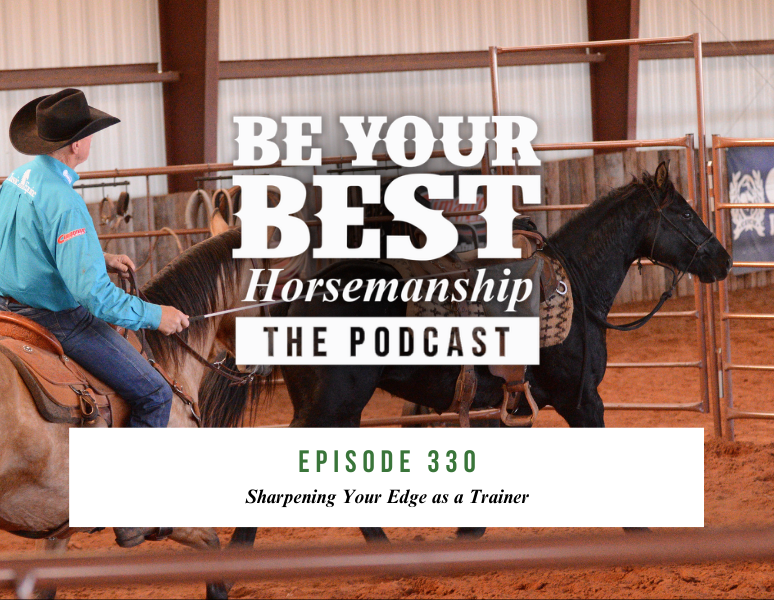
Ep 330: Sharpening Your Edge as a Trainer
One of the things I was reminded of this week while working some four-year-olds is how important it is to keep sharpening your edge as a trainer.
No matter what discipline you're in—barrels, poles, roping, working a cow, whatever it may be—there’s always a point where you have to remind yourself that every response you get from your horse is determined by how well you control your own thoughts and movements.
It always comes back to us.
Our awareness. Our body position. Our timing.
And if we’re not careful, that edge can get a little dull.
Giving the Horse a Chance to Feel You
Earlier this week, I was pen roping calves on a couple four-year-olds in the return lane of my arena. That lane is only about ten or eleven feet wide, and I use it a lot when I’m working young horses.
I’ll put my hand down and let the horse lock onto the object in front of them. Sometimes the calf speeds up, sometimes it slows down. What that does is give me the chance to relax and let the horse feel the change in my body when the situation changes.
That’s incredibly valuable. Because those same changes in body position show up in every discipline. Whether you're running a barrel pattern, working cattle, or roping steers, your horse needs to recognize what your body is telling them. Slow work gives them that opportunity.
Body Position Determines Everything
While we were working horses that day, Millie was riding one in the lane as well. She tracked a calf and went to melt into her stop, but the horse got a little front-end heavy. We talked through it, and I told her if that happens again, squeeze that horse up out of the stop. Because if you allow a horse to stop where the front end sticks in the ground, you're training them to be front-end loaded. That’s going to carry over into whatever discipline you're doing.
And that creates two problems: First, it’s physically hard on the horse. Second, it creates anxiety. A horse that anticipates hitting the ground hard with their front end starts to get insecure when they run. And insecurity leads to tension.
Everything we do—stopping, rating, turning—comes back to the horse’s body position.
If their body is in the right position, the job becomes easier.
Teaching the Horse Where the Release Is
One of the sayings that changed my life years ago came from Martin Black. He said:
“The release is what you teach.”
That idea affects everything I do with horses.
Whether I’m tracking a calf, roping in the lane, or working on stops, my job is to help the horse recognize where the release is.
For example, when I start tracking calves with a horse, I don’t worry about how close I am at first. I might be thirty, forty, even fifty feet behind. That’s fine. We start somewhere.
Over time, I gradually decrease that distance until the horse finds the “sweet spot”—the position where they’re balanced, comfortable, and able to do their job. Once they find that spot, I melt them into a stop and give them a big release. It doesn’t take long for a horse to figure out where they need to be.
When Speed Enters the Picture
As you increase speed, things get more challenging. Once a horse starts quickening their feet and accelerating, it becomes a lot harder for the rider to stay clear with their signals. It’s easy for our hands to get quick. It’s easy to get ahead of the horse. And when that happens, communication gets muddy.
That’s why I’m constantly reminding myself:
Slow yourself down.
Let the horse recognize your signals. Let them recognize the response you're asking for. Let them recognize the release. Clarity creates confidence.
Why Horses Get Anxious
A lot of people blame things like the alleyway, the gate, or the roping box when a horse starts acting up. But most of the time, it isn’t the alleyway or the box.
It’s what happens after.
A barrel horse that jams the front end in the ground every time they turn will start getting nervous before they even enter the arena. A rope horse that experiences confusion or discomfort out in the field may start dreading the box.
Horses are very good at anticipating what comes next. If what comes next is uncomfortable or confusing, they’ll start worrying about it long before it happens. And many times, that traces back to our lack of awareness.
Sharpening Your Edge
I was reminded of something this week when a shoer came by to shoe a few horses. We started talking about knives. These shoeing knives today are made from really good steel. They’re excellent tools. But even the best knife loses its effectiveness if you don’t sharpen it.
Sometimes a farrier will sharpen that knife between every horse. Why? Because the sharper the knife is, the easier the job becomes.
Training horses works the same way. No matter how long you’ve been doing it, you still have to keep sharpening your edge.
For me, that means asking myself:
How clear are my signals today?
Am I aware of what my body is doing?
Am I helping my horse find the release?
Even after more than four decades of training horses, that awareness still requires attention every day.
Horses Reflect Our Competence
The reality is, horses are constantly teaching us. When something isn’t going right, it’s a mirror.
It forces us to ask:
What am I missing in my communication?
Sometimes it only takes a small adjustment to change everything.
I had a trainer on one of our mentorship calls recently who was struggling to pick up the left lead on a horse. After talking through a few things and making a small adjustment to her signals, she sent me a message a couple days later saying it was already working better.
That’s how it goes sometimes. Small awareness. Big difference.
Stay Humble in the Process
This business has a way of keeping you humble.
Young horses haven’t lived long enough to know everything yet. They’re learning every day. And our job is to help them build confidence instead of anxiety.
Sometimes that means dealing with the same challenge for weeks while things gradually improve. That’s part of the process. Just because something is difficult today doesn’t mean it won’t turn into the best horse you’ve ever trained.
At the end of the day, horses will always tell you how good of a job you're doing. You just have to listen.
The results you get—the confidence, the anxiety, the response—that’s your feedback.
So keep sharpening your edge.
Stay aware. Slow yourself down. Be clear with your signals.
Because the better we get at understanding ourselves, the easier it becomes for our horses to understand us.