Ep 331: Establishing Rope Horse Fundamentals
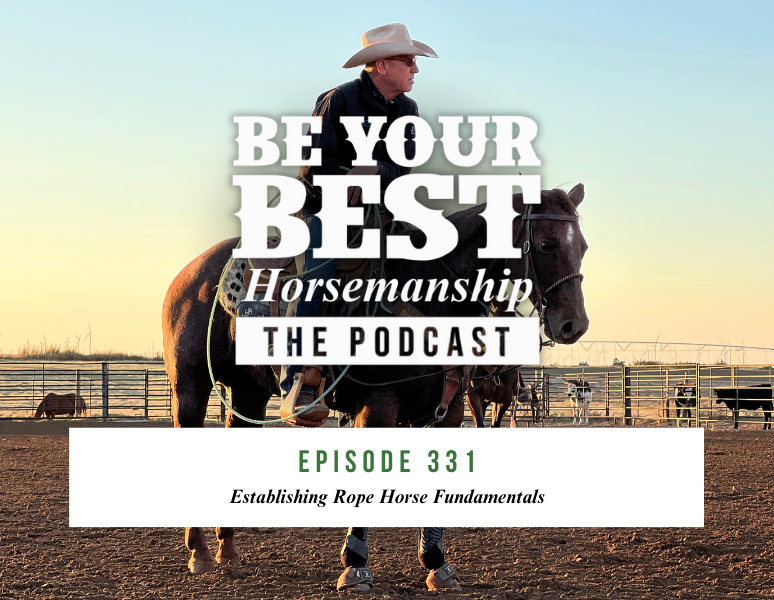
This week, we’ve been doing a lot of work on rope horse fundamentals, especially with younger horses.
And no matter what level of horse you’re riding—whether they’re four years old or seasoned—it all comes back to the same thing: The basics matter.
If you don’t get the fundamentals right early, you’ll spend a lot of time later trying to fix things that could’ve been prevented.
What Happens in the Box Matters
One of the biggest areas we’ve been focused on is box work.
I was roping on three different head horses this week—one young, one middle-aged, and one older—and even though they’re all at different stages, I saw the same thing across all three.
When things are right, those horses will:
Stand flat-footed
Stay relaxed
Stay behind the bridle
Not move until your hand moves
That’s what you’re after.
Now, one of the things I’ve adjusted over the last couple years is how I use my box. I don’t always use a butt bar, and I’ll change the depth of the box depending on the horse.
Why? Because it forces me to be more consistent with my hands and my signals.
A lot of times, when a horse is backed into the corner, we think we’re holding them—but every time we nod, we pull just a little bit more. That creates a pull-back, then go forward situation. That’s not what we want.
Leave Flat and Forward
What I’m looking for is for my horse to leave flat and forward.
Not rocked back. Not crouched. Not jumping out of there.
Because when a horse starts from a crouched position:
They have to lift their front end first
They get out of balance
You end up on their face
And now you’re sending mixed signals:
You’re asking them to go
But you’re also pulling on them
That confusion shows up fast.
Instead, I want everything to feel forward from the start. When that happens, your run becomes a lot simpler and a lot more consistent.
Where this really shows up is in your swing. If your start in the box isn’t right, it’s hard to get your first swing where it needs to be to where you can deliver your rope at any time. If your body position is off in the corner, you’re already behind before you even leave.
That’s why I always say: It all starts in the box.
To Use a Tie Down or Not to Use a Tie Down?
When we’re working with rope horses, another topic that comes up a lot is the great tie-down debate. Some people treat it like a bad word. But at the end of the day, it’s just a tool — just like a bit or anything else we use.
Used correctly, a tie-down can:
Help with balance
Help create consistency
Allow the rider to be quieter with their hands
For example, I had one of my interns riding a four-year-old mare this week with a light tie-down.
Why?
Because it allowed her to:
Keep her hand down
Be more patient
Give the horse time to find the right response
That’s what matters.
Now, do we train softness with a tie-down? No. That work gets done without it. But when you’re adding speed or working in a performance setting, sometimes that tool helps your horse stay balanced and confident.
Speed Changes Everything
Another area we’ve been working on is speed transitions. Going from: Walk → trot → lope → run, and then back down. Most people don’t practice that enough.
When you increase speed, you trigger the horse’s reactive (flight) side. When you slow them back down, they have to switch back to their thinking side.
Because in a run, your horse has to be able to: accelerate, think, and come back to you, and do all three with confidence. That transition doesn’t always look smooth and pretty, but it’s necessary.
Training vs. Competing
Here’s the reality:
When you’re competing, things aren’t always going to be perfect.
Your timing might be off. Your balance might be off. Your hands might not be great.
That’s just part of it.
And sometimes, even when things aren’t perfect—you still win.
That’s why preparation matters so much.
You can’t ride in a competition the same way you ride when you’re training. You have to trust what you’ve built.
Build the Foundation First
At the end of the day, rope horse fundamentals come down to this:
Start with a horse that leaves flat and forward
Keep your signals consistent
Pay attention to body position
Use tools correctly
Follow a program
Build confidence through repetition
Because when the fundamentals are right, everything else gets easier.