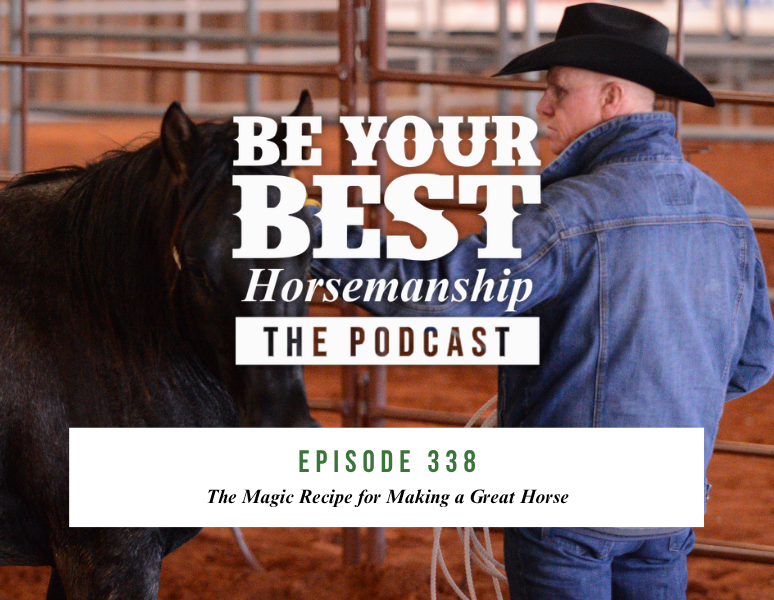
Ep 338: The Magic Recipe for Making a Great Horse
There’s a question I think every trainer gets at some point. People come to clinics or watch videos or spend a day riding with us, and somewhere along the line they’re hoping there’s going to be a “magic recipe” for making a great horse.
The truth is, there isn’t one.
There’s no shortcut. No secret move. No one special drill that suddenly changes everything overnight.
The horses that become great are usually the result of simple fundamentals, repeated consistently over time by somebody willing to stay committed to the process.
That’s it.
And honestly, I think sometimes that’s disappointing for people to hear because we all want progress to happen faster. But the longer I do this, the more convinced I am that the basics done correctly will outperform gimmicks every single time.
Great Horses Are Built Through Consistency
This week we had a couple private clinics here at our place, and one thing that stood out to me was how experienced and talented every rider was. These weren’t beginners. They were skilled horsewomen with a lot of miles and experience.
But even at that level, the biggest improvements came from very small changes.
Sometimes it was simply separating their hands a few more inches. Sometimes it was changing body position slightly. Sometimes it was just slowing down enough to let the horse understand the signal before asking for more.
That’s the part people miss. Big breakthroughs usually come from small adjustments repeated consistently—not dramatic changes.
A lot of times we think we need to completely overhaul everything when really we just need to sharpen up the fundamentals and become more aware of what signals we’re sending our horses.
Because every response, good or bad, starts with us.
Why Fundamentals Matter More Than Fancy Training
At both clinics, we spent a lot of time working through simple exercises. Nothing flashy. Nothing complicated.
One drill we worked on involved two poles set up as visual markers while focusing on softness, forward motion, and counter bend. Simple exercise. But when done correctly, it teaches a horse how to stay soft through their rib cage, free up their shoulders, and continue moving forward with balance and confidence.
Those are foundational pieces that carry over into everything else.
Whether you’re heading steers, running barrels, or just trying to build a softer, more responsive horse, the fundamentals are always the answer.
I think sometimes people underestimate how important those basics really are because they aren’t exciting. But when your horse gets in trouble, when the wheels start coming off, or when pressure gets added, the horse always falls back to their foundation. And, so do we.
Progress Happens When You Eliminate Distractions
One thing I noticed during those clinics was how much progress happened once people disconnected from everything else competing for their attention.
Both groups drove several hours to get here. They left businesses, responsibilities, chores, and busy schedules behind for the day. And once they arrived, their focus shifted completely onto their horses.
That’s when growth started happening.
A lot of times, the reason we stop progressing isn’t because we lack ability. It’s because our attention is divided in ten different directions.
When you finally give yourself uninterrupted time to focus on your horse and your horsemanship, you start noticing details you’ve been missing.
You start feeling timing better.
You start recognizing where your signals aren’t as clear as they need to be.
And most importantly, your horse starts feeling the difference too.
Small Changes Create Big Results
One of the biggest lessons in horsemanship—and honestly life in general—is understanding that small changes over time create massive results.
That’s true with horses.
That’s true with habits.
That’s true with mindset.
Nobody changes a habit in a day.
You change it through awareness and repetition.
That’s why I tell people all the time: just start somewhere. Do something. Keep working at it. Because progress compounds.
Sometimes we want to fix everything at once, but that usually just creates frustration for both us and the horse. The better approach is to make one adjustment, stay aware of it daily, and allow that change to become consistent over time. That’s how real improvement happens.
Don’t Get Greedy When It’s Going Good
One thing I constantly remind myself of—especially with talented young horses—is knowing when to quit.
I was riding a really nice three-year-old filly this week that felt incredible. Soft. Responsive. Connected. She was really trying. And when a horse feels that good, it’s tempting to keep asking for more and more.
But sometimes the smartest thing you can do is get off. Don’t get greedy just because it’s going well.
A lot of training problems start because we ask for ten more things after we already got exactly what we needed. Great horsemen learn to recognize those moments and protect the horse’s confidence instead of pushing past the point of progression.
There Is No Magic—Only Commitment
At the end of the day, the “magic recipe” people are looking for is really just commitment to the basics.
Clear signals
Consistent fundamentals
Awareness
Patience
Repetition
Timing
Feel
That’s what builds confidence in a horse. And honestly, it’s what builds confidence in us too.
The longer I do this, the more I realize there’s no finish line where you suddenly have everything figured out. We’re all still learning. We’re all still refining our timing, improving our communication, and trying to become better horsemen. That’s the journey. And if you stay committed to the process long enough, those small daily improvements eventually turn into something pretty special.