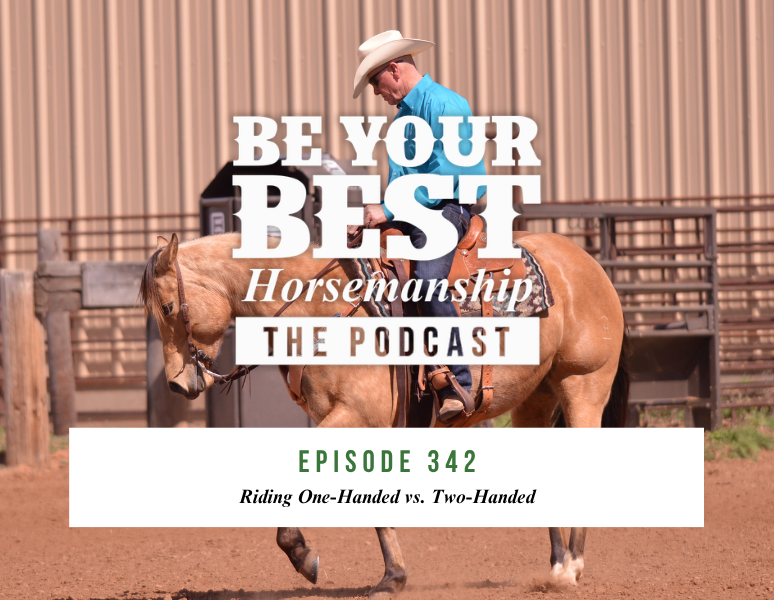
One of the topics that comes up frequently at my clinics is riding a horse one-handed versus two-handed. Most people assume it's simply a matter of discipline or preference. In reality, riding one-handed is one of the best ways to evaluate your foundation and find out exactly how broke your horse really is.
Now, don't get me wrong. We need both. When we're starting horses, tuning horses, or teaching new concepts, we're going to spend a lot of time riding two-handed. Two hands allow us to create clearer signals, offer more support, and help our horses understand exactly what we're asking for. But at some point in the process, you've got to put one hand down and see what you've really built.
Riding One-Handed Exposes the Gaps
The minute you drop down to one hand, your horse starts telling you the truth.
Does that neck rein actually mean something? Does your horse move off that rein laid against their neck? When you pick up your hand and put a little life in the bridle reins, does your horse connect through their face, mind, body, and feet? Or do things start falling apart?
A lot of times, riding one-handed reveals disconnects that we don't notice when we're helping the horse with two hands. You find out if your horse will stay between your reins and your legs. You find out whether they'll hold a straight line. You find out whether they understand your feel or whether they're simply responding to constant correction.
That's valuable information. Because if things fall apart at a walk, trot, or lope, they're probably going to fall apart even faster when speed and pressure get added.
The Mind-Body Connection
One of the concepts I talk about all the time is connecting to the horse's feet through their mind.
Everything starts with the mind. When I can connect to a horse's mind, I can influence their body position. When I influence their body position, I can direct their feet. That's really what training is all about.
Riding one-handed is a great way to test that connection.
Can your horse stay on a straight line when you put your hand down? Can they make a smooth turn without excessive rein pressure? Can they transition up and down while staying soft and connected?
If the answer is yes, you're building a solid foundation.
If the answer is no, that's not failure. It's simply feedback telling you what needs more work.
Why Two-Handed Riding Still Matters
Sometimes people hear discussions about one-handed riding and assume they should stop riding two-handed altogether. That's not the case.
In fact, I think riding exclusively one-handed can create problems.
If you never go back and work with two hands, many horses start losing some of their softness. They can become a little stiffer, a little more rigid, and a little less responsive laterally.
That's why I constantly move back and forth between the two.
I'll warm horses up two-handed. I'll go through my checklist. I'll make sure I have communication with all five body parts. I'll make sure the horse is soft and connected.
Then I'll put one hand down and see how much of that communication remains.
The goal isn't choosing one style over the other. The goal is using both tools to create a better horse.
Good Habits Create Better Results
One of the examples we discussed recently involved a couple young colts that wanted to speed up every time they entered a smaller circle. That's a common issue.
Many horses begin associating certain rein signals with acceleration rather than relaxation. Instead of slowing down and softening into the turn, they anticipate more pressure and speed up.
When that happens, the solution isn't to force them harder. It's to create better habits.
If the horse wants to speed up in a smaller circle, teach them to slow down. Go into the circle at a slower walk. Then a slower trot. Build the habit of relaxing, softening, and staying connected.
Over time, good habits make the correct response easier.
A Simple Drill That Tells You Everything
One of my favorite exercises is incredibly simple.
Set two poles or markers a good distance apart. Lope from one to the other one-handed. Make a smooth half-circle around the marker, then ride straight to the next one and repeat.
Sounds easy. But, you'll learn a lot. You'll find out if your horse drifts off the line. You'll find out if they're listening to your body. You'll find out whether they can maintain direction without constant correction.
At first, many horses feel like a balloon with the air leaking out. They drift left. They drift right. They lose focus.
That's okay. Simply put them back on the line and continue. Over time, they begin understanding the responsibility of staying between your hands and legs. More importantly, they begin learning to stay connected to your feel.
How Broke Is Your Horse?
The reason I believe so strongly in one-handed riding is because it gives us an honest evaluation of our training.
You should be able to walk, trot, lope, and maneuver your horse one-handed on a loose rein. That doesn't mean they'll be perfect. It doesn't mean you'll never need to help them. But it does mean they understand the fundamentals. And if they understand the fundamentals at a slower speed, they'll be far more likely to hold things together when pressure increases.
At the end of the day, riding one-handed isn't about showing off. It's not about making things look fancy. It's about finding out how solid your foundation really is.
Because when the pressure is on, whether you're running barrels, roping steers, or competing in any performance event, you need a horse that understands your signals, stays connected to your mind, and responds through their feet. The best way to find that out is to put one hand down and see what you've got.