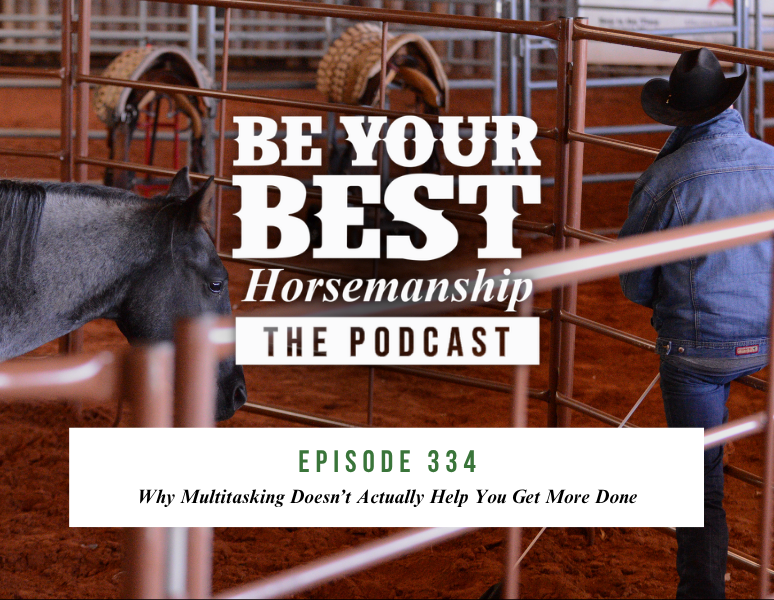
Ep 334: Why Multitasking Doesn’t Actually Help You Get More Done
One of the things I’ve really spent time thinking about this year—and something that’s made a big difference in my training—is the idea of multitasking.
For a long time, I took pride in being able to juggle a lot of things at once. We all do it. We’ve got horses to ride, places to be, people to call, and a list that never seems to get any shorter.
But here’s what I’ve come to realize: just because we’re doing multiple things at once doesn’t mean we’re actually focused on more than one thing.
Because the truth is, we’re not.
It’s been proven that the human mind can only hold one thought or one process at a time. You can have multiple things going on—but your actual focus? That’s only on one of them.
And when it comes to horsemanship, that matters more than we probably realize.
The Problem With Focusing on the End Result
Where this really shows up is when we get fixated on the outcome instead of the process.
Take roping, for example. When you’re running up on a calf, what are you thinking about?
Most of the time, you’re thinking about catching the neck. That’s the end result.
But what happens when we skip the step before that?
We forget to prepare. We forget to slow down our delivery. We don’t give our loop time to open or our tip time to drop. And all of a sudden, something that should be simple becomes difficult.
Not because we’re not capable—but because we skipped a step.
Same thing in barrel racing. If all you’re thinking about is the turn, but you’re not thinking about the signal that prepares your horse for that turn, you’re setting both of you up for a struggle.
That’s where you see the wrestling match. That’s where timing gets off. That’s where things fall apart.
And a lot of it comes back to this: we’re trying to think about too much at once, and in doing that, we miss what matters most in that moment.
The “Signal Before the Signal”
One of the biggest separators I see in really good horsemen is their ability to focus on the step before the step.
I call it the “signal before the signal.”
Before the stop, there’s preparation.
Before the turn, there’s a warning.
Before the delivery, there’s a change in your body that helps your horse get ready.
If we’re only focused on the final move, we’re too late.
But when we slow down mentally and stay present in each step, everything gets easier—for us and for the horse.
Because now they’re not reacting—they’re understanding.
Why Multitasking Hurts Your Horsemanship
Here’s the reality: when your attention is divided, your communication gets unclear.
Your horse doesn’t feel two things at once. They feel whatever you’re focused on in that moment.
So if your mind is already at the next step, but your body hasn’t prepared them for it yet, they’re going to be late… or confused… or reactive.
And then we end up trying to fix it with more pressure, more correction, more effort.
When really, it started with our focus.
I’ve caught myself doing this plenty of times. I’ll be working a horse, talking on the phone, thinking about something else—and the second that horse needs my attention, everything else has to stop.
Because I can’t do both well. None of us can.
Do One Thing. Finish It. Move On.
This doesn’t just apply in the saddle—it applies to everything we do.
When I look at my day now, instead of trying to do ten things at once, I focus on doing one thing at a time.
Start it.
Finish it.
Move to the next.
Same thing with your horse.
Instead of thinking about the whole run, focus on the first step. Then the next. Then the next.
That’s how you build consistency.
That’s how you build confidence.
That’s how you improve your timing.
And ultimately, that’s how you get better results.
Final Thoughts
Multitasking might make us feel productive—but in reality, it’s often making things harder than they need to be.
In horsemanship, especially, success comes from being present.
From focusing on the moment you’re in.
From thinking one step at a time.
From helping your horse understand what’s coming next.
Because at the end of the day, better focus leads to better communication. And better communication is what great horsemanship is all about.