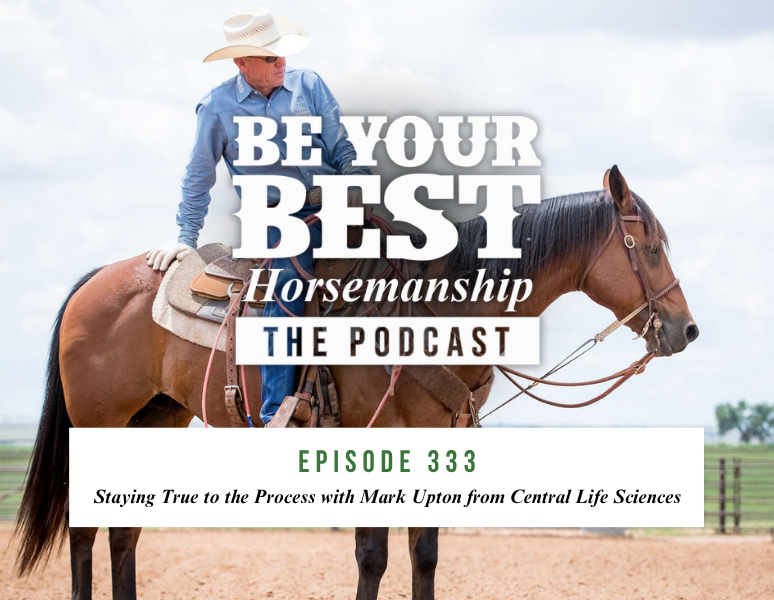
This week on the podcast, I had my good friend Mark Upton from Central Life Sciences on the show, and we had a really good conversation about something that applies to every horseman, no matter your discipline or your schedule: staying true to the process.
Mark and I have known each other a long time, and over the years we’ve each played different roles in taking horses from start to finish. In his case, that’s mostly been in the rope horse world. In mine, it’s been starting colts, building the foundation, and helping those horses get to the next step.
What made this conversation so good is that Mark represents a lot of people out there. He’s got a demanding career, a full life, and he’s not riding horses all day every day. But he’s still built a really solid program because he stays committed to the process.
Selecting the Right Prospects
One of the first things we talked about was selecting the right prospect.
That’s a challenge for a lot of people because there are a lot of horses for sale and a lot of good horses out there. But just because a horse is talented doesn’t mean it fits what you’re trying to do.
Mark’s raised a lot of his own horses, and over time he’s gotten more intentional about breeding for what fits his program. That matters. You need a plan before you ever swing a leg over one. What discipline fits? What type of mind fits? What kind of horse can you realistically develop with the time and resources you have?
That’s the first part of staying true to the process — being honest about where you’re going and what fits.
A Strong Foundation Still Matters Most
We spent a lot of time talking about the value of foundation.
You hear it all the time, but the reason you hear it all the time is because it’s true. If a horse doesn’t have something to come back to when the wheels come off the wagon, it’s going to be real hard to put things back together.
And the wheels are going to come off at some point.
That’s not failure. That’s training.
Whether you’re roping calves, heading steers, running barrels, or just trying to progress a young horse, there are going to be days where you put a little more pressure on and all of a sudden the horse tells you exactly where the holes are.
That’s valuable information. The problem is, too many people take that as a sign that something’s wrong, when really it’s just the next step in the process.
Variety Makes Better Horses
One thing Mark does that I think is really beneficial is he gives his horses some variety.
He ropes calves on them. He tracks cattle. He puts them in the round pen. He does enough different things with them that they keep learning how to respond to his body, his timing, and his feel. That’s huge.
I’m a big believer in using calf roping, tracking, or flag work to help horses understand speed, direction, and body position. If a horse can lock onto an object, stay straight, rate, stop, and find a release point, that’s going to carry over into just about any discipline.
And when you mix those things up, it keeps both the horse and the rider more aware. It improves your horsemanship because you can’t just go through the motions.
Being Realistic with Your Time
When it comes to horses, a lot of us have big expectations for what we want to accomplish. The problem is, a lot of us also tend to overestimate the time we have to dedicate to their progress.
Mark was honest about the fact that it takes him longer to get a horse where he wants it because he doesn’t have unlimited time. But that doesn’t mean he’s doing it wrong. It just means he’s working within his schedule.
That’s a lesson more people need to hear.
Not everybody gets five or six rides a week on a young horse. Not everybody can spend all day in the saddle. So, you have to be realistic―and if it takes you longer, it takes you longer.
That’s not a problem unless you start expecting your horse to be somewhere they’re not ready to be.
That’s where frustration comes in. That’s where people start forcing things. And that’s where confidence gets torn down instead of built up.
Mental Maturity Matters
One of the best parts of the conversation was talking about the mental side of training.
Because the truth is, a lot of this comes down to maturity — not just in the horse, but in the rider.
You’ve got to be able to look at a horse honestly and say, “This is where we’re at today.” Not where you wish you were. Not where somebody else’s horse is. Not where you hoped to be by now. Just where you are.
And then from there, the question becomes: what do I need to do today to help this horse?
That shift in thinking makes a huge difference. Instead of getting mad because things aren’t perfect, you start listening. You start adjusting. You start working with the horse in front of you instead of the one in your head. That’s growth.
Good Practice Has a Purpose
We also talked about practice, and this is another place where people can really help themselves.
Practice ought to have a purpose. Don’t just back in the box and nod over and over because that’s what you’ve always done. Don’t just go through the motions. Set up situations. Think through the run. Ask yourself what your horse needs. Ask yourself what you need.
A lot of times people think practice is just repetition. But repetition without purpose doesn’t create progression. Perfect practice may not create perfection — because there is no perfection — but it does create confidence, consistency, and awareness. And, that’s what you’re after.
Paying Attention to Every Piece of the Process
Another piece of staying true to the process is paying attention to the little management details that affect your horses every day — and fly control is one of them. If your horse is constantly stomping, swishing, or distracted, they’re not fully focused on the job in front of them. That affects training, confidence, and progression more than people sometimes realize. Keeping horses comfortable, staying on top of your place, and managing flies well is all part of the process too. It may seem like a small thing, but small things add up in a big way over time.
Mark’s an expert on this topic and knows firsthand the impact that a solid fly control program has on making the process that much more efficient and effective. Some of the go-to fly control products mentioned in this episode are:
The Process Is the Point
At the end of the day, this whole conversation came back to one big idea: You’ve got to stay true to the process.
That means:
being honest about your time,
building a real foundation,
letting the horse tell you where they’re weak,
not rushing through pressure,
and understanding that progression is rarely linear.
Some days it’s going to feel like you took a big step forward. Some days it’s going to feel like you backed up. That’s part of it.
But if you stay with the process, if you keep putting in the time, if you keep making good decisions, it adds up.
That’s true whether you’re a full-time trainer or somebody fitting horses in around work and family.
There’s no shortcut around the process. But if you stay with it, it’ll take you where you want to go.