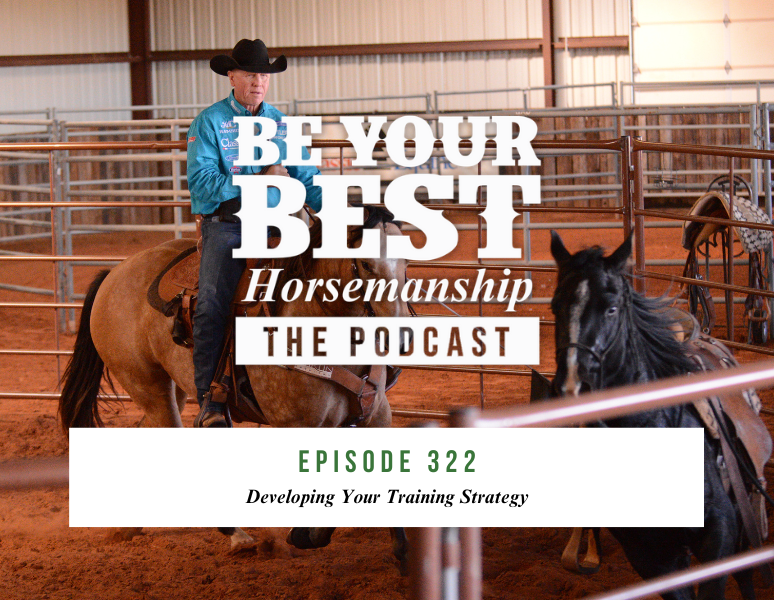
Ep 322: Developing Your Training Strategy
One thing I’ve learned over the years—whether it’s training horses, competing, or helping others develop their program—is this: goals don’t mean much without a strategy.
It’s easy to slap a big goal on the calendar. Everybody can do that. “I want this horse ready by summer.” “I want to win here.” “I want to be competitive by the end of the year.” The goal itself is the easy part.
The hard part is figuring out how you’re actually going to get there.
Goals Are Easy. Planning is the Work.
I had a conversation this week with a customer who purchased a couple of young prospects from us. They asked for a strategy meeting—something very few people actually do—and I’ll be honest, that alone told me a lot.
We talked about the long-term goal first. That’s always simple. Everybody has a wish list item: a futurity, a big arena, a big moment. There’s nothing wrong with that.
But then we backed it up and asked the real question:
Where do we realistically need to be in six months?
That’s where most people get uncomfortable, because now you’re forced to be honest. You can’t just “see how it goes.” I tried that approach early on in my rodeo career, and I was never where I wanted to be when it mattered.
What I’ve learned is this: If you don’t define where you want to be in six months, you’ll drift. And drifting is expensive—time-wise, mentally, and with your horse.
Break It Down Into Manageable Pieces
I like working in six-month increments. It’s long enough to make meaningful progress, but short enough to evaluate honestly.
Ask yourself:
Where is this horse today?
Where do I want them to be six months from now?
What needs to happen—physically and mentally—to get there?
That doesn’t mean rushing. It means being intentional.
With young horses especially, I’m not worried about how fast they can run. Speed will come. What I care about is whether they’re mentally and physically prepared to handle pressure without falling apart.
If your strategy depends on everything lining up perfectly on competition day, your odds of success are slim. A solid strategy builds consistency—so that when you show up and do your job, you always have a chance.
Foundation Creates Freedom
A horse that’s prepared mentally gives you freedom physically.
When a horse understands how to stay in the thinking side of their brain under pressure, you get to be the leader—not the manipulator. You can guide them instead of fighting them.
That’s what seasoning really is. It’s not about throwing a horse into the fire and hoping the wheels don’t fall off. It’s about exposing them to the world while keeping the foundation intact.
And that only happens if you know what you’re trying to develop, not just where you’re trying to go.
Strategy Requires Regular Check-Ins
A strategy isn’t something you write down once and forget about.
You need to check in with yourself regularly:
Are we making progress?
Are we reinforcing the right things?
Are we solving problems—or creating new ones?
This came up again this week with one of my interns working a young gelding that’s extremely watchy by nature. She got stuck trying to desensitize him to the point where she was tiptoeing around him—and it made him worse.
The solution wasn’t more caution. The solution was clarity.
Once she saw how direct, confident movement helped that horse relax and trust, everything changed. And the next day, she applied the same concept successfully on her own.
That’s what strategy does—it gives you direction when things get uncomfortable.
There’s No Substitute for Time in the Saddle
You cannot think your way into experience. You can gather all the information in the world, but without application, it doesn’t stick. Strategy becomes clearer the more time you spend in the saddle, not less.
The more horses you ride, the better you get at reading them.
The better you read them, the more effective your decisions become.
And the more effective your decisions become, the closer you get to the goals you set.
Nobody gets a pass in this business. Horses will challenge you. You’ll get frustrated. You’ll question yourself. That’s part of it.
The people who make it aren’t the ones who avoid those moments—they’re the ones who keep working through them.
Have a Strategy for More Than Just Your Horses
This doesn’t just apply to training horses.
You need a strategy for:
Your personal development
Your mindset
Your business and brand
Personal development affects horsemanship more than most people realize. If you’re not growing, your program won’t either.
So as you look ahead, don’t just ask yourself what you want to accomplish. Ask yourself:
What systems need refining?
What habits need strengthening?
What needs more consistency?
Have the meeting. Make the plan. Check in regularly.
Goals are great—but strategy is what gets you there.