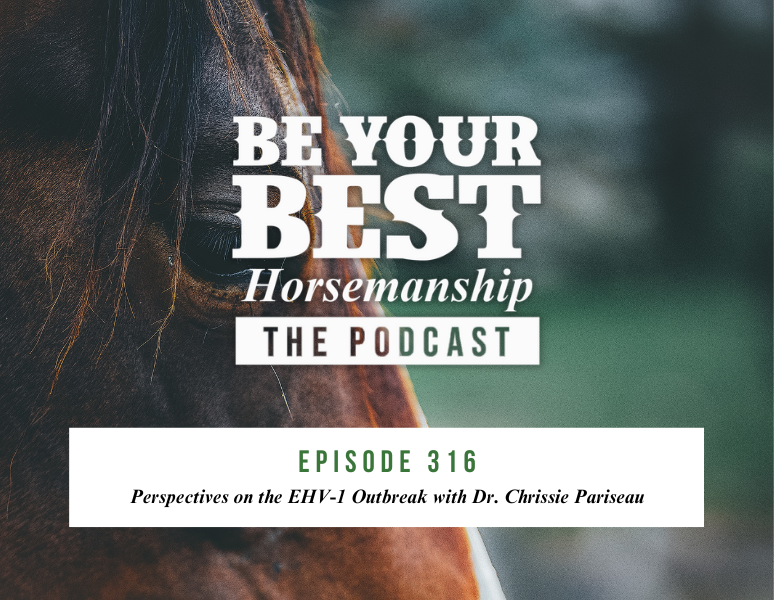
In this episode, I am pleased to welcome Chrissie Pariseau, DVM, MS, DABVP, cVMA with Merck Animal Health to share some perspectives on the current EHV-1 outbreak.
Join us as Dr. Pariseau unpacks the myths and facts about EHV-1 and EHM, including her professional recommendations for monitoring symptoms, testing for the virus, protecting healthy horses in your herd, and caring for those that have been exposed or infected.
Understanding What EHV-1 Really Is (And Isn’t)
EHV stands for equine herpesvirus. There are multiple types of this virus, but EHV-1 is the one causing concern right now. Dr. Pariseau stressed that while the neurological symptoms of EHV-1 are alarming, most of the time, EHV-1 only causes a mild respiratory illness. Occasionally, when infected horses display neurological symptoms, that’s the scary part we all hear about.
While neurological symptoms are uncommon, it’s serious when it happens. People also like to say there’s a “neurologic strain” and a “non-neurologic strain.” According to Dr. Pariseau, that’s not really accurate. Any EHV-1 strain has the potential to cause neurologic disease. But, this doesn’t mean that we jump straight to “if my horse gets EHV-1, they’re automatically going to become a neurologic train wreck.” That’s not how it works.
It’s a serious virus, but it’s not new. It’s something we can manage with good decisions and good biosecurity practices.
How The EHV-1 Virus Spreads
EHV-1 spreads a few different ways:
Nose-to-nose contact – horses touching noses over a stall door, in the alleyway, at the trailer.
Short-range aerosols – a horse coughing or snorting nearby.
Contaminated surfaces – this is the big one. Hoses. Buckets. Bits. Brushes. Muck forks. Our hands. Our boots. Our clothes. Trailer walls. Stall doors.
The good news is, this virus isn’t bulletproof. It doesn’t require some exotic disinfectant. If you clean off the visible dirt and mucus first, then hit those surfaces with a good disinfectant, you can kill it.
Dr. Pariseau said in most real-world situations, if you don’t clean and disinfect anything, the virus can survive about seven days on surfaces. Clean and disinfect, and you stack the odds way back in your favor.
The Lifespan of an EHV-1 Outbreak
Dr. Pariseau stressed the importance of understanding that the lifespan of an EHV-1 outbreak like this is directly tied to how well we stop moving horses and respect quarantine. That’s it.
The more we load up, haul to events, mix our horses with other herds, share space and equipment—the more horses get exposed, and the longer the virus sticks around.
I understand as well as anybody that staying home has a cost. For some of you, this is your livelihood. But I also know that the quicker we tighten things up, the sooner we’ll all be back to business as usual.
At my own facility, we did our own version of a self-imposed lockdown: no horses in, no horses out, unless they were headed to the vet and back. That was our decision based on our situation and comfort level, and it made sense to me. Every place is different, but the principle is the same—movement fuels spread.
Protecting Healthy Horses and Caring for Exposed and Infected Horses
Dr. Pariseau broke down a simple way to think about managing horses during a situation like this. If you’ve got any mix of:
Healthy, unexposed horses
Horses that may have been exposed
Sick horses (fever, respiratory signs, neurologic signs)
You work them in this order:
Healthy / unexposed
Exposed but not sick
Sick
And you treat those groups like three separate barns. In a perfect world, you’d have different people for each group. In the real world, most of us don’t. So the next best thing is:
Change clothes or throw on/strip off coveralls between groups.
Wash your hands or use sanitizer.
Clean or disinfect your boots (foot bath, boot brush, etc.).
Use separate buckets, muck forks, and feed equipment for each group.
It’s not fancy. It’s just discipline. But, it makes a huge difference.
Monitoring and Recognizing Early EHV-1 Symptoms
Fever is usually the first sign of EHV-1. Dr. Pariseau indicated that the general fever cutoff for horses is around 101.5°F, but what really matters is what’s normal for your horse. If your horse usually runs 99.2–99.6°F and suddenly they’re at 101°F, that’s still meaningful.
If you see a temperature that causes alarm:
Isolate that horse.
Call your vet.
Let them guide you on testing and next steps.
It’s always better to quarantine early and not need it than to wish you had.
One thing I really appreciated that Dr. Pariseau pointed out is how NSAIDs (like bute, banamine, Equioxx, etc.) can mask fevers.
A lot of performance horses are on something to keep them comfortable when they’re traveling and showing. That doesn’t make you a bad horse owner—it means your horses are being used and you’re managing them. But if you take their temperature after you’ve given the drug, you’re not getting a true reading.
Her advice was simple: if you’re going to give an NSAID, take the temperature before you dose. And if your horse is on an NSAID regularly, talk to your vet about what number should trigger concern in that context.
Quarantine and Testing for EHV-1
Dr. Pariseau said a question that comes up a lot is: “If my horse was at an event where EHV-1 was present, and I bring them home and get a negative PCR test, are we in the clear?”
The uncomfortable answer is: not necessarily.
Here’s why:
A horse can be exposed on day 0 and not show a fever or start shedding virus for up to six or seven days.
If you swab too early—particularly on day 1 of a fever—you can get a false negative, simply because the horse isn’t shedding much virus yet.
The recommendation Chrissie shared was:
Quarantine exposed horses for a minimum of 21 days, even if they look fine.
Check temperatures twice daily.
If they develop a fever or signs, your quarantine clock restarts from that day, and you work with your vet on testing.
Some facilities and regulatory groups may recommend testing out of quarantine near the end of that 21–28 day window. Follow their guidance.
I know that’s not the answer any of us want when we’re staring at a big event circled on the calendar. But, the cost of cutting quarantine short and dragging this out nationwide is a lot higher than missing one show.
EHV-1 Vaccination: What It Can Help With—and What It Can’t
According to Dr. Pariseau, there’s no vaccine on the market right now that’s been proven to prevent the neurologic form of EHV-1 (EHM). That doesn’t mean vaccines are useless—far from it. With EHV, the goal of vaccination is to:
Help reduce respiratory disease
Help reduce how much virus a horse sheds if they do get infected
That’s a big deal when you’re talking about herd-level protection.
The AAEP recommends most horses that travel or regularly mix with others get vaccinated for EHV twice a year, often as part of a flu/rhino combination (covering EHV-1, EHV-4, and influenza).
For pregnant mares, Merck has a product called Prestige® Prodigy—an EHV-1 only, high-antigen-load vaccine that’s commonly given in the 5th, 7th, and 9th months of gestation to help reduce the risk of EHV-1–related abortion. It also helps reduce respiratory disease and shedding in other horses, under veterinary direction.
In the current situation, Dr. Pariseau’s suggestion was to talk with your vet about whether your horse might benefit from a booster if it’s been three months or more since their last rhino shot. If your horse was just boosted 30–60 days ago, it probably doesn’t need another right now.
Again, this isn’t about building an invisible shield—it’s about improving the percentages and lowering the overall viral pressure in the environment.
Where to Get EHV-1 Updates and Information
With the buzz circulating on social media, it can be challenging to decipher myths from facts. Dr. Pariseau pointed us to the Equine Disease Communication Center (EDCC) for the most up-to-date information. They publish confirmed alerts from state vets and have excellent biosecurity guidelines written in plain language.
On top of that, your primary sources should always be:
Your veterinarian
The event or facility’s official communications
State veterinary and regulatory announcements
My Takeaways as a Trainer and Horse Owner
Here’s what I walked away with from this conversation and what I hope sticks with you:
Watch your horses. Take temps twice a day. Catch things when they’re a burning match, not a dumpster fire.
Clean and disinfect like it matters—because it does. Don’t just rinse and hope.
Respect quarantines. It’s not just about your barn; it’s about the protection on an industry level.
Don’t panic‐medicate. Don’t flood your horses with antibiotics “just in case.” Call your vet, get a plan, stick to it.
Keep your vaccination program current and thoughtful. Work with your vet, especially if you’re hauling.
Lean on reputable sources. Filter the Facebook posts and reach out to credible, professional equine veterinary specialists and industry-level resources.
At the end of the day, our horses are our partners, our livelihood, and for a lot of us, our therapy. Nobody is out there trying to be careless. Most of the time we’re just juggling a lot and doing the best we can with the information we have.
My hope is that conversations like this—with people like Dr. Pariseau—give you better information, so you can keep doing right by your horses with a little more confidence and a little less fear.
As always—take care of your horses, take care of each other, and today and every day, let’s be our best.