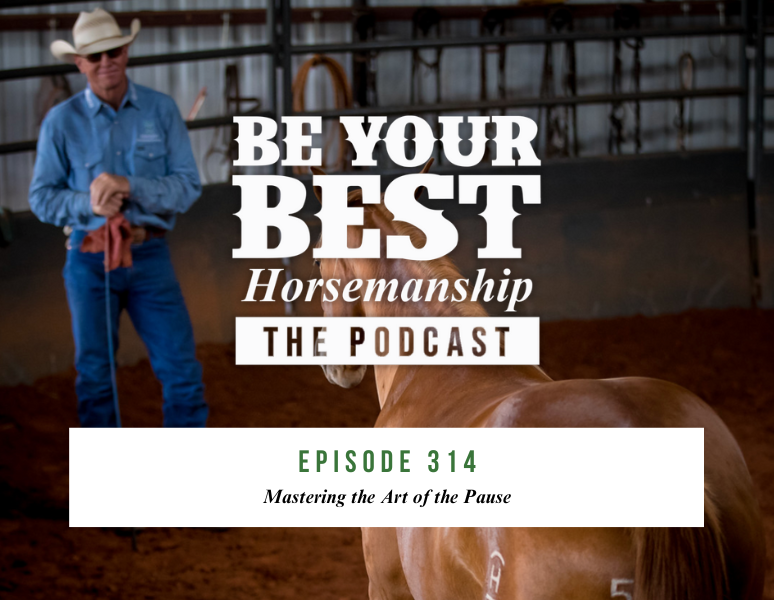
Mastering the art of the pause is one of the most—if not the most—critical skills you can develop in your horsemanship journey. The pause (the reward) is that brief moment that tells your horse it found the correct response. It’s the cue that says “good job.”
Just like people, horses need a moment of positive reinforcement to feel confident and secure in what they’re doing. Any time you teach a new skill, there’s a level of uncertainty a horse will feel. The pause, simple as it seems, is the piece that builds certainty—step by step.
Why Self-Awareness Matters
Developing better self-awareness is a constant journey, and it’s one I’ve prioritized because of the monumental impact it has on my horsemanship. When I control my thoughts and stay focused, I get a better connection with my horse. Without distractions—or rushed, negative energy—it’s just me and that horse.
All my attention is on refining the process of getting the correct response through clear communication and leadership. Focus on the moment, and focus on the horse that’s in front of you right now.
The Process of Getting a Response
When you’re working for a response, walk yourself through this 5-step process:
What exactly am I asking for?
How will I ask in a way my horse can understand?
Ask. Be clear with your signal and stay with it until your horse finds the answer.
Release. Offer the release at the right time.
Pause. Let them sit in the release for 5–10 seconds.
That last step—the pause—is critical. It signals, “you did it right.” Without it, the lines between one exercise and the next blur. If you rush from maneuver to maneuver, your horse struggles to tell where one signal stops and the next begins. That confusion can create frustration in the horse, which then shows up as frustration in the rider.
Patience Is Your Teacher
The results the pause creates are tremendous, but it can be the hardest part to master because our default is to hustle and expect immediate results. Slow down. Pause. Quit thinking about everything else you need to do and be present.
Not only release—pause. Give them time to feel it and enjoy that moment of rest that says, “good job.” The pause is one of the simplest skills to do, yet one of the hardest to own, because it runs counter to our efficiency-driven rhythm.
Can Effort Be Taught?
At one of our clinics this fall, someone said, “Well, you can’t teach effort, right?” I didn’t address it in the moment, but I disagree. I believe effort can be taught—in horses and in people. Effort is shaped by environment.
If you’re surrounded by support, high standards, and frequent “good jobs,” you’re trained to give more effort. Horses are no different. The release-and-reward (pause) system is the framework that teaches effort:
A clear signal sets the expectation.
The release marks the correct answer.
The pause is the praise—your “good job.”
Just like we need positive reinforcement, so do our horses.
Sharpen the Axe
“Give me six hours to chop down a tree, and I’ll spend the first four hours sharpening my axe.” —Abraham Lincoln
A good friend of mine up in North Dakota, Nate Horner, sent me that quote. To me, it’s all about preparation. Refining your signals and refining your process—that’s the sharpening phase.
The biggest challenge in preparation is making it a priority. Schedule it. Protect it. When you do, the asking, the release, and the pause all get cleaner—and your horse’s understanding grows with it.
Bottom line: Slow down and let the pause do its work. That five to ten seconds is where confidence is built, understanding is locked in, and your partnership with your horse is strengthened.