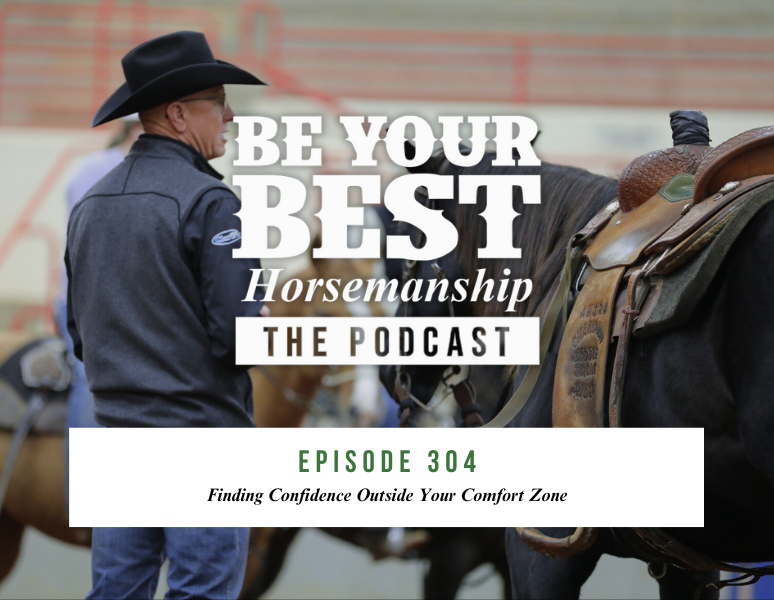
Ep 304: Finding Confidence Outside Your Comfort Zone
Labor Day is supposed to be a holiday, but around here it lived up to its name. If you’ve ever run a training facility, you know there’s always something to do—fences to fix, pastures to mow, arenas to work, horses to care for. I’m grateful for what we’ve built since we bought this old farm back in ’99, but every building you add comes with a new line item called maintenance. Truth is, the easiest thing we do around here is train horses. Everything else is the price of admission.
Progress Requires Discomfort
Last night a trainer called with questions about an upcoming clinic. She’s sharp, works hard, and like most good hands, she’s her own toughest critic. Underneath the questions was a familiar worry: Am I ready? Will my horse be ready?
Here’s the truth: I rarely meet anyone who “feels” ready. In 45 years of riding for the public, I’ve never looked at a colt and thought, I’m way ahead on this one. We always think we should be farther along. That feeling doesn’t mean don’t go. Most of the time it means exactly the opposite—do it. If you wait until everything’s perfect, you’ll never leave the house.
A clinic is not where you “fix” your horse. It’s where you train yourself—your feel, your timing, your balance, your understanding of release points. You take that clarity home, and your horse benefits for months. Sometimes the most productive thing you can do is bring a horse you’re comfortable on, learn the system, and then apply it to your greener ones. Get out of your comfort zone without overwhelming your horse. That’s smart horsemanship.
Build Your Program (and Stop Comparing)
Your program should be unique to you. Mine is unique to me. It’s a blend of a lot of teachers, miles, mistakes, and small wins. You can admire someone else’s program without turning yours into a copy. The only non-negotiables are these:
Clear signals that make sense to the horse
Consistent responses you can recognize
Timely releases that reward the thought and the try
Signals create responses; responses earn the release. That loop—repeated with consistency—is what builds understanding and confidence.
Efficient Progress Beats Fast Progress
Everybody wants to go faster. Few want to get more efficient. Fast progress is fragile. Efficient progress is durable. You earn efficiency by honoring the steps in order. Skip steps and you don’t save time—you buy frustration: bracy bodies, reactive minds, defensive feet. When we go step by step, each piece prepares the horse for the next piece. That’s where softness and reliability come from.
The Colts Don’t Lie
We’ve got a couple sensitive ones in the string right now—catty, feely, not naturally “gentle.” They’ll tell on me in the first 30 seconds of the day. If I roll into the lot like I’ve got five minutes to catch the whole pasture, their heads pop up and their eyes get big. If I walk in like I’ve got all morning—breathe, rub a back, rub a neck, then halter—their bodies melt 10%. That 10% shows up all day. The horses feel what we bring to them. Our vibe becomes their baseline.
Same in the box. If I act like I’ve got to run ten steers in twenty minutes, my horse feels the hurry. If I act like I’ve got all day to run two, he finds stillness faster. Feel, timing, and balance aren’t talents I “have”—they’re skills I practice every day.
Training Mode vs. Competition Mode
I talked recently about the difference between training mode and competition mode. Both matter. If all you ever do is “train,” you’ll compete like a trainer—safe, late, and behind. If all you ever do is “compete,” your horse will come apart. The art is separating them inside a single practice:
Put it on in the chute and practice position, rate, and handle without the throw. That’s training mode for the horse.
Then switch to competition mode for you—score sharp, ride first, deliver early, and live with a few misses while you sharpen your first shot.
You can’t find competitive timing by playing it safe. You also can’t build a solid horse by living in redline every run. Split the session. Teach the horse. Then go try to win something.
Goals, Seasons, and the Clock That Doesn’t Stop
I turned 61 in August. I feel great, but I’m still aware that Father Time is undefeated. If there are things you want to do—go to a clinic, enter a roping, start a colt, try a new discipline—the window isn’t getting bigger. Don’t confuse “not ready” with “not capable.” The only way to get ready is to start.
Look a year out. Where do you want to be with your horsemanship, your business, your relationships, your faith, your finances, your health? Pick one thing in each category that would move the needle—and go do the uncomfortable first step. The longer you wait for perfect conditions, the louder doubt gets.
Practical Ways to Step Outside the Comfort Zone
Choose the horse that sets you up to learn. Green on green rarely builds confidence.
Define one training focus per ride. Clarity beats complexity.
Score more than you think you need. Stillness is a skill.
Release with intent. When the horse finds the thought you want, reward it now.
Practice your first shot. On the dummy and on cattle—pick up and deliver. Fewer swings, more decisions.
Slow down. Your horse will tell you when you’re hurrying.
Audit your day. What improved? What got sticky? What’s the very next step?
Final Thought
If you’re waiting to “feel ready,” you’ll be waiting a long time. Confidence isn’t the prerequisite; it’s the result. Get a little uncomfortable. Do the thing. Then do it again tomorrow—with better feel, better timing, and a quicker release.
Have a great week of training. God bless each and every one of you. And as always, today and every day—let’s be our best.