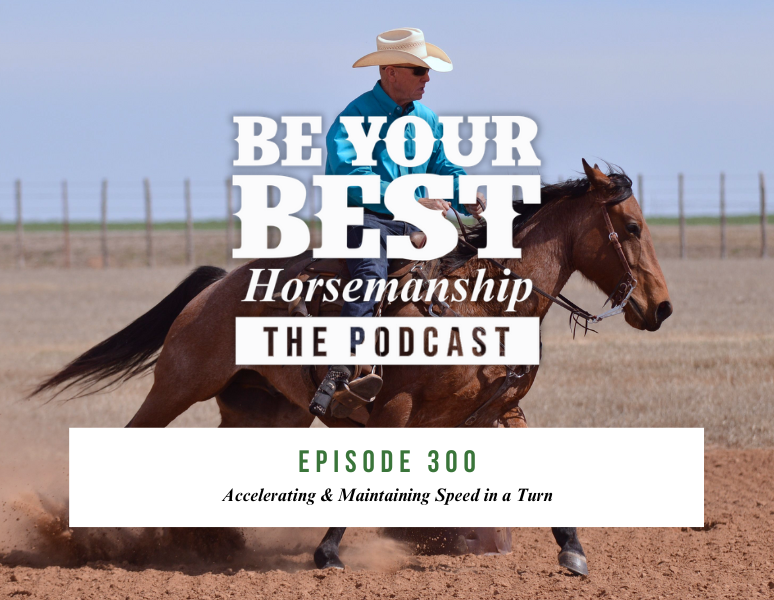
This week’s episode is a special one—it marks the 300th episode of the Be Your Best Horsemanship podcast. We’ve been doing this for nearly six years now, and with the exception of one week we missed recently, we've showed up every single week. I’m thankful for all of you who keep listening and learning with me.
Let’s dive into something that came up in a conversation I had over morning coffee with Bridget this week. I asked her, “What are two things you feel would improve performance in the arena?” Without skipping a beat, she said:
Acceleration
Speeding a horse’s feet up in a turn
And, I couldn’t agree more.
Why Acceleration Matters
In speed events—whether it’s roping or barrel racing—if your horse can’t accelerate and maintain forward momentum through a turn, you’re setting yourself up for a disadvantage. Too often, we work on turning without momentum or slow into the turn so much that the horse braces, gets stiff through the ribcage, and we end up front-end loaded. It doesn’t feel good, and it’s not fast.
Establishing Forward Momentum in the Turn
I’ve been roping on a young mare that Bridget’s been running barrels on. We raised her, and she’s got maybe a dozen runs under her belt. She’s broke, rides great, but when we got her inside a pen in Utah, she felt tight—like she wasn’t really opening up between barrels. She was running, but not running to go catch something. That’s a huge distinction.
So this week, we’re not even focusing on roping. I’m going to put my hand down and just let her hook it across the arena after the cow. Doesn’t matter if I swing a rope or not. The goal is that when my hand drops, she learns to run with intent—to move with purpose. Over time, that kind of consistent cue and application will carry over to the barrel pen. It becomes muscle memory.
When Speed Helps a Horse Stay Soft
When a horse carries momentum into a turn, the motion itself helps keep them softer. It may sound backward, but it’s true. If your horse is creeping into a turn or already bracing before it begins, they’re going to get stiff through the ribcage and lock up in the front end. But if they’ve got some speed and they’re reaching under themselves with their hind end, that front end will naturally follow. They’ll pedal through the turn instead of jamming into it.
That’s something I work on constantly. Whether I’m on a rope horse or a colt, if I feel them start to brace or get front-end loaded, I know I’ve gotten too handsy. That’s my sign to put my hand down, soften up, and get back to letting them figure it out. The more I help without overhelping, the more confident they get and the smoother the turns become.
Train the Habit Before You Need It
With horses, habits start with intention. One of the best things you can do to help a horse with acceleration is to start off working on that feel long before it’s ever asked for in competition. I’ve had to remind myself of that lately while preparing Boone for some ropings. When I put my hand down, Boone runs at a cow like he’s mad—like he’s got a job to do. That kind of intent is something I want all my horses to feel. It makes everything else easier.
Whether you’re running barrels or heading steers, that mindset of “go catch it” builds the kind of rhythm and response you’re going to need when it matters.
The Role of Consistency and Feel
Another thing I’ve realized is that acceleration and fast feet in a turn both come down to feel. Can you keep your hand down through the turn? Can your horse stay soft while moving fast? Those are big asks, but when you’ve built the foundation right—when you’ve worked through the stiffness, the hesitation, the anticipation—they’ll be able to do it.
Every week, I get reminders from the horses I ride that the answer is usually to get back to the basics. Get your horse listening, not anticipating. Keep them soft, not defensive. Let them learn how to use their bodies instead of micromanaging every move. That’s where the magic happens.
Wrapping It Up
As always, I appreciate you spending a little time with me. Whether you’re training for the next big event or just trying to improve your everyday rides, I hope this gives you something to think about this week.
And if you’re looking to dive deeper into topics like this, we’ve got some upcoming clinics and mentorships this fall—some are already full, but a few still have spots left. If you’ve got questions, reach out to us and we’ll get you taken care of.
Until next time—God bless, and today and every day, let’s be our best.